Kingdom
Pseudomonadati
Phylum
Pseudomonadota
Class
Gammaproteobacteria
Order
Vibrionales
Family
Vibrionaceae
Genus
Vibrio
Description
Taxonomy
| Kingdom | Pseudomonadati |
|---|---|
| Phylum | Pseudomonadota |
| Class | Gammaproteobacteria |
| Order | Vibrionales |
| Family | Vibrionaceae |
| Genus | Vibrio |
| Species | Vibrio parahaemolyticus |
| Strain | 229 |
Profile
| Physiology | |
|---|---|
| Gram staining properties | Negative |
| Shape | Rod |
| Mobility | Yes |
| Flagellar presence | Yes |
| Number of membranes | 2 |

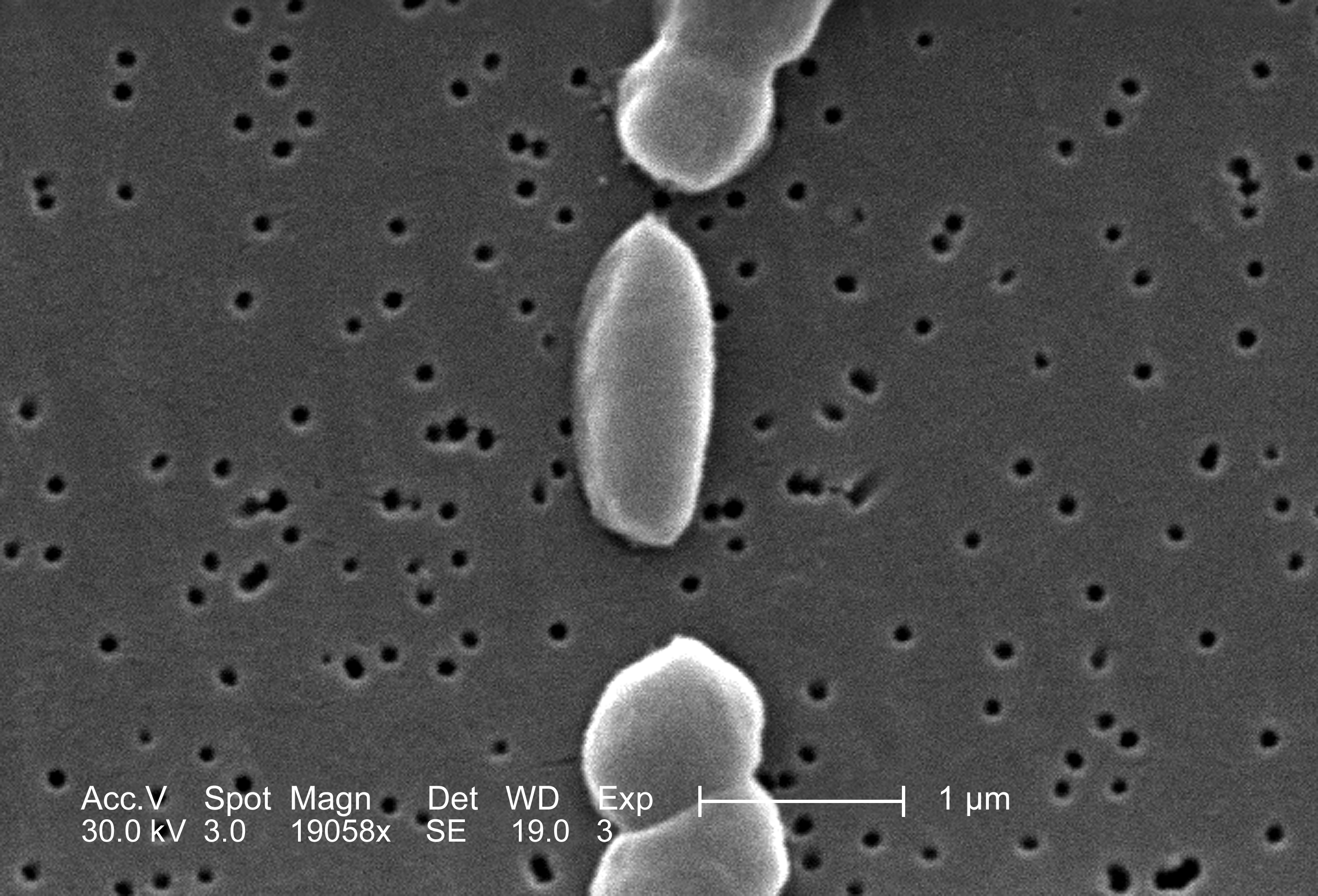
Image source: Wikipedia/Wikimedia
| Ecology, Host, and Life Cycle | |
|---|---|
| Oxygen requirements | Facultative anaerobe |
| Optimal temperature | 20 |
| Temperature range | Mesophilic |
| Habitat | Aquatic |
| Biotic relationship | Free living |
| Host(s) | Homo sapiens, Danio rerio, Pancrustacea |
| Cell arrangement | Singles |
| Sporulation | Nonsporulating |
| Energy source | Heterotroph |
| Pathogenicity | Human |
Gene Summary
Adenine Count
1322847 bp
Thymine Count
1331750 bp
Guanine Count
1051784 bp
Cytosine Count
1037083 bp
Genome Length
4743464 bp
Protein-coding Genes
4491 genes
Non-Coding Genes
64 genes
# of Chromosomes/Plasmids
1
Genes
| Name | Locus Tag | UniProt ID | Strand Orientation | Gene Start/End | Protein Molecular Weight |
|---|---|---|---|---|---|
| dna-binding response regulator | BS585_21430 | Not Available | Negative | 4380190 - 4380786 | 22330.0 |
| diguanylate phosphodiesterase | BS585_21435 | Not Available | Negative | 4380779 - 4381945 | 44168.3 |
| histidine kinase | BS585_21440 | Not Available | Negative | 4381929 - 4385594 | 136825.0 |
| hypothetical protein | BS585_21445 | Not Available | Negative | 4386069 - 4386551 | 18261.5 |
| molybdenum cofactor biosynthesis family protein | BS585_21450 | Not Available | Negative | 4386581 - 4387462 | 34252.1 |
| ribosome biogenesis gtpase ylqf | BS585_21465 | Not Available | Positive | 4388726 - 4389670 | 36093.8 |
| cai-1 autoinducer synthase | BS585_21470 | Not Available | Positive | 4390024 - 4391205 | 43852.7 |
| hybrid sensor histidine kinase/response regulator | BS585_21475 | Not Available | Negative | 4391283 - 4393331 | 78222.2 |
| mfs transporter | BS585_21490 | Not Available | Negative | 4395960 - 4397093 | 40440.6 |
| arac family transcriptional regulator | BS585_21495 | Not Available | Positive | 4397233 - 4398012 | 29465.6 |
Pathways
21 pathways
No pathways found
No metabolic pathways have been associated with this bacterium yet.
Health Effects
| Health Condition | Relation | Reference |
|---|---|---|
| Vibriosis | Causes | PMC10472736 |
| Acute gastroenteritis | Causes | PMC11171697 |
| Wound infections | Causes | PMC11171697 |
| Septicemia | Causes | PMC11171697 |
| Food poisoning | Causes | PMC12108532 |
| Vibrio infections | Causes | PMC12108532 |
| Acute gastroenteritis | Causes | PMC12849298 |
| Wound infections | Causes | PMC12849298 |
| Ear infections | Causes | PMC12849298 |
| Septicemia | Causes | PMC12849298 |