Kingdom
Pseudomonadati
Phylum
Pseudomonadota
Class
Gammaproteobacteria
Order
Vibrionales
Family
Vibrionaceae
Genus
Vibrio
Description
Taxonomy
| Kingdom | Pseudomonadati |
|---|---|
| Phylum | Pseudomonadota |
| Class | Gammaproteobacteria |
| Order | Vibrionales |
| Family | Vibrionaceae |
| Genus | Vibrio |
| Species | Vibrio parahaemolyticus |
| Strain | No strain |
Profile
| Physiology | |
|---|---|
| Gram staining properties | Negative |
| Shape | Rod |
| Mobility | Yes |
| Flagellar presence | Yes |
| Number of membranes | 2 |

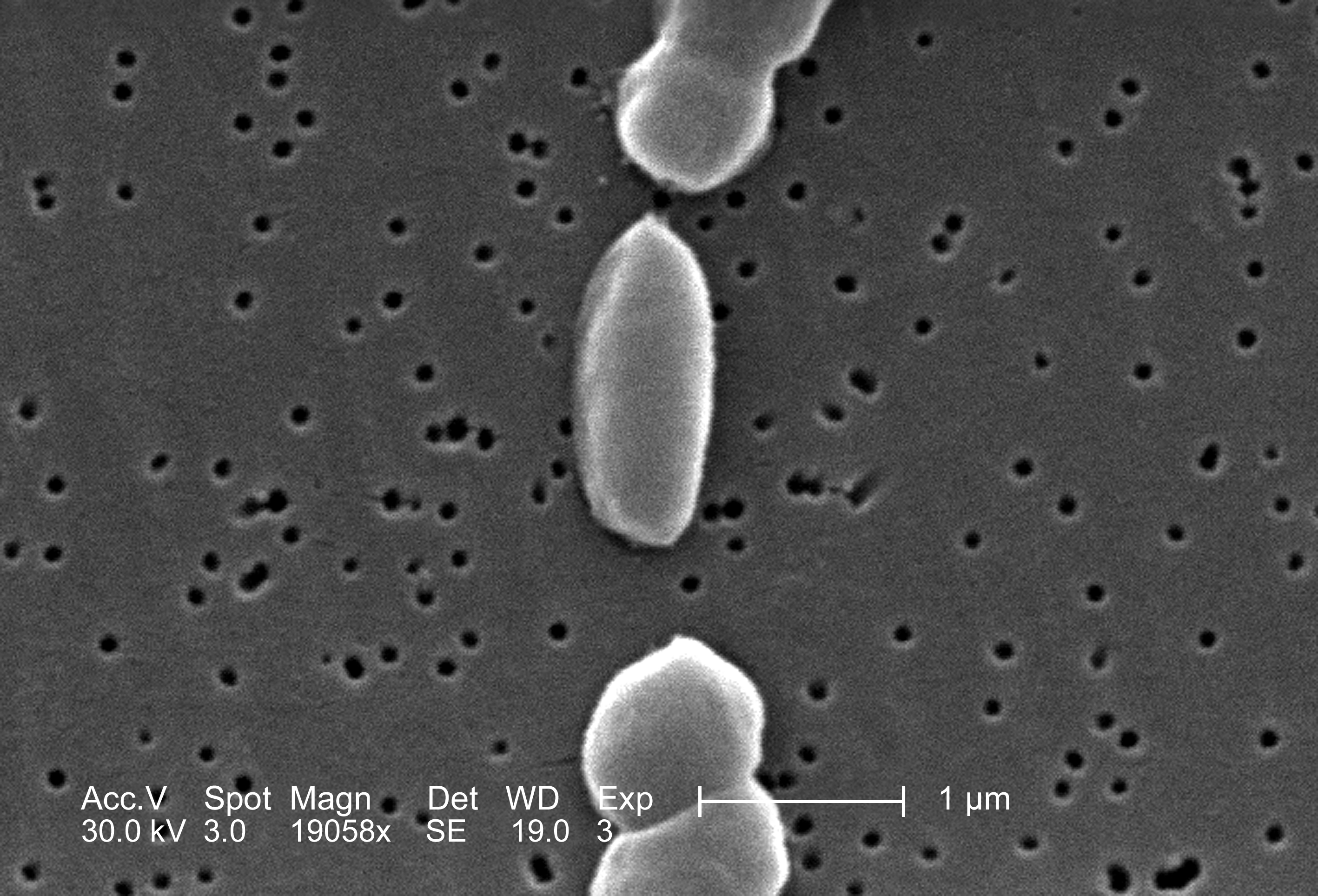
Image source: Wikipedia/Wikimedia
| Ecology, Host, and Life Cycle | |
|---|---|
| Oxygen requirements | Facultative anaerobe |
| Optimal temperature | 20 |
| Temperature range | Mesophilic |
| Habitat | Aquatic |
| Biotic relationship | Free living |
| Host(s) | Homo sapiens, Danio rerio, Pancrustacea |
| Cell arrangement | Singles |
| Sporulation | Nonsporulating |
| Energy source | Heterotroph |
| Pathogenicity | Human |
Genome Summary
Vibrio parahaemolyticus strain NA2 contig81, whole genome shotgun
Gene Summary
Adenine Count
1503030 bp
Thymine Count
1509893 bp
Guanine Count
1266974 bp
Cytosine Count
1226470 bp
Genome Length
5512119 bp
Protein-coding Genes
5167 genes
Non-Coding Genes
180 genes
# of Chromosomes/Plasmids
7
Genes
| Name | Locus Tag | UniProt ID | Strand Orientation | Gene Start/End | Protein Molecular Weight |
|---|---|---|---|---|---|
| Capsid scaffolding protein | D5E78_11620 | Not Available | Negative | 2067416 - 2068273 | 32332.4 |
| Terminase large subunit | D5E78_11625 | Not Available | Positive | 2068440 - 2070212 | 67859.2 |
| Portal protein | D5E78_11630 | Not Available | Positive | 2070209 - 2071237 | 38913.1 |
| Zinc-finger protein | D5E78_11635 | Not Available | Positive | 2071316 - 2071567 | 9258.13 |
| Hypothetical protein | D5E78_11640 | Not Available | Negative | 2071569 - 2071841 | 9721.77 |
| hypothetical protein | D5E78_11645 | Not Available | Positive | 2072202 - 2072993 | 29473.6 |
| hypothetical protein | D5E78_11650 | Not Available | Positive | 2072983 - 2073399 | 15783.5 |
| Replication gene a protein | D5E78_11655 | Not Available | Negative | 2073403 - 2073705 | 11622.4 |
| hypothetical protein | D5E78_11660 | Not Available | Negative | 2073870 - 2074445 | 21738.6 |
| hypothetical | D5E78_11665 | Not Available | Negative | 2074445 - 2075177 | 25683.6 |
Pathways
1174 pathways
Health Effects
| Health Condition | Relation | Reference |
|---|---|---|
| Vibriosis | Causes | PMC10472736 |
| Acute gastroenteritis | Causes | PMC11171697 |
| Wound infections | Causes | PMC11171697 |
| Septicemia | Causes | PMC11171697 |
| Food poisoning | Causes | PMC12108532 |
| Vibrio infections | Causes | PMC12108532 |
| Acute gastroenteritis | Causes | PMC12849298 |
| Wound infections | Causes | PMC12849298 |
| Ear infections | Causes | PMC12849298 |
| Septicemia | Causes | PMC12849298 |