Kingdom
Pseudomonadati
Phylum
Pseudomonadota
Class
Gammaproteobacteria
Order
Enterobacterales
Family
Enterobacteriaceae
Genus
Shigella
Description
Taxonomy
| Kingdom | Pseudomonadati |
|---|---|
| Phylum | Pseudomonadota |
| Class | Gammaproteobacteria |
| Order | Enterobacterales |
| Family | Enterobacteriaceae |
| Genus | Shigella |
| Species | Shigella sonnei |
| Strain | 75/02 |
Profile
| Physiology | |
|---|---|
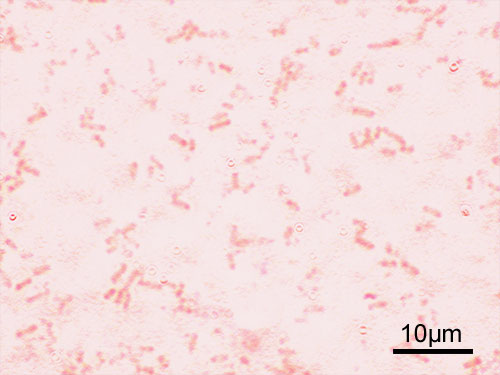
| Gram staining properties | Negative |
| Shape | Rod |
| Mobility | No |
| Flagellar presence | Yes |
| Number of membranes | 2 |

Image source: Wikipedia/Wikimedia
| Ecology, Host, and Life Cycle | |
|---|---|
| Oxygen requirements | Facultative anaerobe |
| Optimal temperature | 37 |
| Temperature range | Mesophilic |
| Habitat | HostAssociated |
| Biotic relationship | Free living |
| Host(s) | Homo sapiens, Metazoa, Pteropodidae |
| Cell arrangement | Pairs - Singles |
| Sporulation | Not Available |
| Energy source | Chemoorganotroph |
| Pathogenicity | Not Available |
Genome Summary
Shigella sonnei strain 75/02 plasmid p75-02_5, complete sequence.
Gene Summary
Adenine Count
1326 bp
Thymine Count
1417 bp
Guanine Count
1244 bp
Cytosine Count
1127 bp
Genome Length
5114 bp
Protein-coding Genes
4 genes
Non-Coding Genes
0 genes
# of Chromosomes/Plasmids
5
Genes
| Name | Locus Tag | UniProt ID | Strand Orientation | Gene Start/End | Protein Molecular Weight |
|---|---|---|---|---|---|
| ycei family protein | BZ172_RS20805 | Not Available | Negative | 3858298 - 3858873 | 20913.6 |
| cytochrome b | BZ172_RS20810 | Not Available | Negative | 3858877 - 3859443 | 20709.5 |
| is1-like element is1a family transposase | BZ172_RS20820 | Not Available | Positive | 3859527 - 3860224 | 26455.2 |
| n-methyl-l-tryptophan oxidase | BZ172_RS20830 | Not Available | Negative | 3860315 - 3861433 | 40916.2 |
| biofilm formation regulator bsss | BZ172_RS20835 | Not Available | Negative | 3861548 - 3861802 | 9664.31 |
| dna damage-inducible protein i | BZ172_RS20840 | Not Available | Negative | 3862092 - 3862337 | 8949.43 |
| dihydroorotase | BZ172_RS20845 | Not Available | Negative | 3862411 - 3863457 | 38829.6 |
| lipoprotein | BZ172_RS20850 | Not Available | Negative | 3863563 - 3864123 | 20513.0 |
| glutaredoxin 2 | BZ172_RS20855 | Not Available | Negative | 3864257 - 3864904 | 24351.6 |
| multidrug efflux mfs transporter mdth | BZ172_RS20860 | Not Available | Negative | 3864968 - 3866176 | 44468.2 |
Pathways
16 pathways
No pathways found
No metabolic pathways have been associated with this bacterium yet.
Health Effects
| Health Condition | Relation | Reference |
|---|---|---|
| Shigellosis | Causes | PMC2600399 |
| Shigellosis | Causes | PMC5177732 |
| Diarrheal disease | Causes | PMC5177732 |
| Shigellosis | Causes | PMC6038740 |
| Shigellosis | Causes | PMC2271788 |
| Shigellosis | Causes | PMC5447701 |
| Bacterial dysentery | Causes | PMC5447701 |
| Diarrhea | Causes | PMC8886675 |
| Dysentery | Causes | PMC8886675 |
| Shigellosis | Causes | PMC8886675 |