Kingdom
Pseudomonadati
Phylum
Pseudomonadota
Class
Gammaproteobacteria
Order
Enterobacterales
Family
Enterobacteriaceae
Genus
Shigella
Description
Taxonomy
| Kingdom | Pseudomonadati |
|---|---|
| Phylum | Pseudomonadota |
| Class | Gammaproteobacteria |
| Order | Enterobacterales |
| Family | Enterobacteriaceae |
| Genus | Shigella |
| Species | Shigella dysenteriae |
| Strain | No strain |
Profile
| Physiology | |
|---|---|
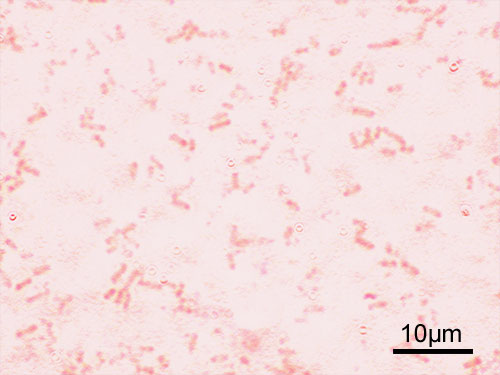
| Gram staining properties | Negative |
| Shape | Rod |
| Mobility | No |
| Flagellar presence | Yes |
| Number of membranes | 2 |

Image source: Wikipedia/Wikimedia
| Ecology, Host, and Life Cycle | |
|---|---|
| Oxygen requirements | Facultative anaerobe |
| Optimal temperature | 37 |
| Temperature range | Mesophilic |
| Habitat | HostAssociated |
| Biotic relationship | Free living |
| Host(s) | Homo sapiens, Metazoa, Primates |
| Cell arrangement | Pairs - Singles |
| Sporulation | Not Available |
| Energy source | Chemoorganotroph |
| Pathogenicity | Not Available |
Gene Summary
Adenine Count
1232144 bp
Thymine Count
1216307 bp
Guanine Count
1250889 bp
Cytosine Count
1272262 bp
Genome Length
4982938 bp
Protein-coding Genes
4744 genes
Non-Coding Genes
267 genes
# of Chromosomes/Plasmids
3
Genes
| Name | Locus Tag | UniProt ID | Strand Orientation | Gene Start/End | Protein Molecular Weight |
|---|---|---|---|---|---|
| flagellar basal body rod protein flgb | NCTC4837_02822 | Not Available | Positive | 2433559 - 2433975 | 15299.2 |
| flagellar basal body rod protein flgc | NCTC4837_02823 | Not Available | Positive | 2433979 - 2434383 | 13998.8 |
| flagellar basal body rod modification protein | NCTC4837_02824 | Not Available | Positive | 2434395 - 2435090 | 23627.5 |
| flagellar hook protein flge | NCTC4837_02825 | Not Available | Positive | 2435115 - 2436323 | 42000.5 |
| flagellar basal body rod protein flgf | NCTC4837_02826 | Not Available | Positive | 2436606 - 2437094 | 16705.8 |
| flagellar basal body rod protein flgg | NCTC4837_02827 | Not Available | Positive | 2437232 - 2437480 | 8943.62 |
| flagellar basal body rod protein flgg | NCTC4837_02828 | Not Available | Positive | 2437547 - 2438014 | 16389.2 |
| flagellar l-ring protein precursor | NCTC4837_02829 | Not Available | Positive | 2438067 - 2438765 | 24616.9 |
| flagellar basal body p-ring protein | NCTC4837_02830 | Not Available | Positive | 2438777 - 2439874 | 38216.0 |
| flagellar basal body protein flgj | NCTC4837_02831 | Not Available | Positive | 2439874 - 2440815 | 34499.2 |
Pathways
0 pathways
No pathways found
No metabolic pathways have been associated with this bacterium yet.
Health Effects
| Health Condition | Relation | Reference |
|---|---|---|
| Shigellosis | Causes | PMC5177732 |
| Hus | Causes | PMC7320338 |
| Shigellosis | Causes | PMC8742002 |
| Bacillary dysentery | Causes | PMC8742002 |
| Bacillary dysentery | Causes | PMC11098424 |
| Bacillary dysentery | Causes | PMC11143797 |
| Shigellosis | Causes | PMC11143797 |
| Epidemic shigella dysentery | Causes | PMC4445032 |