Kingdom
Pseudomonadati
Phylum
Pseudomonadota
Class
Gammaproteobacteria
Order
Enterobacterales
Family
Enterobacteriaceae
Genus
Shigella
Description
Taxonomy
| Kingdom | Pseudomonadati |
|---|---|
| Phylum | Pseudomonadota |
| Class | Gammaproteobacteria |
| Order | Enterobacterales |
| Family | Enterobacteriaceae |
| Genus | Shigella |
| Species | Shigella dysenteriae |
| Strain | No strain |
Profile
| Physiology | |
|---|---|
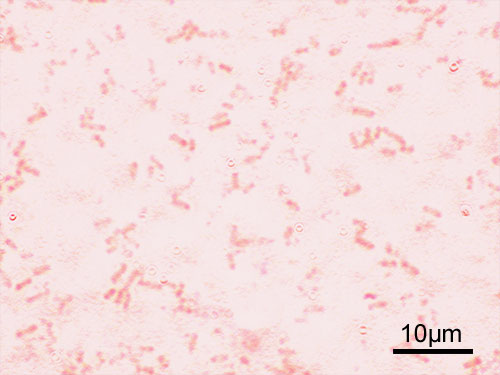
| Gram staining properties | Negative |
| Shape | Rod |
| Mobility | No |
| Flagellar presence | Yes |
| Number of membranes | 2 |

Image source: Wikipedia/Wikimedia
| Ecology, Host, and Life Cycle | |
|---|---|
| Oxygen requirements | Facultative anaerobe |
| Optimal temperature | 37 |
| Temperature range | Mesophilic |
| Habitat | HostAssociated |
| Biotic relationship | Free living |
| Host(s) | Homo sapiens, Metazoa, Primates |
| Cell arrangement | Pairs - Singles |
| Sporulation | Not Available |
| Energy source | Chemoorganotroph |
| Pathogenicity | Not Available |
Gene Summary
Adenine Count
1232144 bp
Thymine Count
1216307 bp
Guanine Count
1250889 bp
Cytosine Count
1272262 bp
Genome Length
4982938 bp
Protein-coding Genes
4744 genes
Non-Coding Genes
267 genes
# of Chromosomes/Plasmids
3
Genes
| Name | Locus Tag | UniProt ID | Strand Orientation | Gene Start/End | Protein Molecular Weight |
|---|---|---|---|---|---|
| 30s ribosomal protein s1 | NCTC4837_02527 | Not Available | Positive | 2187489 - 2189162 | 61134.4 |
| integration host factor subunit beta | NCTC4837_02528 | Not Available | Positive | 2189322 - 2189606 | 10651.8 |
| comec family competence protein | NCTC4837_02529 | Not Available | Positive | 2189813 - 2192077 | 84587.2 |
| lipid transporter atp-binding protein/permease | NCTC4837_02530 | Not Available | Positive | 2192114 - 2193862 | 64464.6 |
| tetraacyldisaccharide 4'-kinase | NCTC4837_02531 | Not Available | Positive | 2193859 - 2194845 | 35556.2 |
| uncharacterized protein conserved in bacteria | NCTC4837_02532 | Not Available | Positive | 2194882 - 2196114 | 47620.5 |
| protein ycar | NCTC4837_02533 | Not Available | Positive | 2196166 - 2196348 | 6855.35 |
| 3-deoxy-manno-octulosonate cytidylyltransferase | NCTC4837_02534 | Not Available | Positive | 2196345 - 2197091 | 27611.1 |
| uncharacterised protein | NCTC4837_02535 | Not Available | Positive | 2197245 - 2198138 | 34517.6 |
| duf218 domain | NCTC4837_02536 | Not Available | Negative | 2198115 - 2198894 | 28694.0 |
Pathways
0 pathways
No pathways found
No metabolic pathways have been associated with this bacterium yet.
Health Effects
| Health Condition | Relation | Reference |
|---|---|---|
| Shigellosis | Causes | PMC5177732 |
| Hus | Causes | PMC7320338 |
| Shigellosis | Causes | PMC8742002 |
| Bacillary dysentery | Causes | PMC8742002 |
| Bacillary dysentery | Causes | PMC11098424 |
| Bacillary dysentery | Causes | PMC11143797 |
| Shigellosis | Causes | PMC11143797 |
| Epidemic shigella dysentery | Causes | PMC4445032 |