Kingdom
Pseudomonadati
Phylum
Pseudomonadota
Class
Gammaproteobacteria
Order
Enterobacterales
Family
Enterobacteriaceae
Genus
Shigella
Description
Taxonomy
| Kingdom | Pseudomonadati |
|---|---|
| Phylum | Pseudomonadota |
| Class | Gammaproteobacteria |
| Order | Enterobacterales |
| Family | Enterobacteriaceae |
| Genus | Shigella |
| Species | Shigella dysenteriae |
| Strain | No strain |
Profile
| Physiology | |
|---|---|
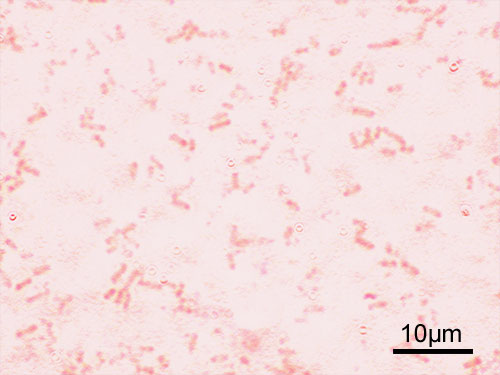
| Gram staining properties | Negative |
| Shape | Rod |
| Mobility | No |
| Flagellar presence | Yes |
| Number of membranes | 2 |

Image source: Wikipedia/Wikimedia
| Ecology, Host, and Life Cycle | |
|---|---|
| Oxygen requirements | Facultative anaerobe |
| Optimal temperature | 37 |
| Temperature range | Mesophilic |
| Habitat | HostAssociated |
| Biotic relationship | Free living |
| Host(s) | Homo sapiens, Metazoa, Primates |
| Cell arrangement | Pairs - Singles |
| Sporulation | Not Available |
| Energy source | Chemoorganotroph |
| Pathogenicity | Not Available |
Gene Summary
Adenine Count
1232144 bp
Thymine Count
1216307 bp
Guanine Count
1250889 bp
Cytosine Count
1272262 bp
Genome Length
4982938 bp
Protein-coding Genes
4744 genes
Non-Coding Genes
267 genes
# of Chromosomes/Plasmids
3
Genes
| Name | Locus Tag | UniProt ID | Strand Orientation | Gene Start/End | Protein Molecular Weight |
|---|---|---|---|---|---|
| putative beta-galactosidase, beta subunit | NCTC4837_00145 | Not Available | Negative | 122051 - 122515 | 17065.7 |
| nagc-like transcriptional regulator | NCTC4837_00146 | Not Available | Negative | 122512 - 123387 | 29584.7 |
| n-acetylmannosamine-6-phosphate 2-epimerase | NCTC4837_00147 | Not Available | Negative | 123384 - 124073 | 24146.1 |
| sialic acid transporter | NCTC4837_00148 | Not Available | Negative | 124121 - 125611 | 53584.4 |
| n-acetylneuraminate lyase | NCTC4837_00149 | Not Available | Negative | 125720 - 126613 | 32595.4 |
| transcriptional regulator nanr | NCTC4837_00150 | Not Available | Negative | 126735 - 127526 | 29552.0 |
| iso-is1 orf2 | NCTC4837_00151 | Not Available | Negative | 127853 - 128257 | 15258.7 |
| iso-is1 orf1 | NCTC4837_00152 | Not Available | Negative | 128276 - 128548 | 10338.4 |
| putative c4-dicarboxylate transporter | NCTC4837_00153 | Not Available | Positive | 128692 - 129000 | 10535.7 |
| clpxp protease specificity-enhancing factor | NCTC4837_00154 | Not Available | Negative | 129043 - 129540 | 18387.6 |
Pathways
0 pathways
No pathways found
No metabolic pathways have been associated with this bacterium yet.
Health Effects
| Health Condition | Relation | Reference |
|---|---|---|
| Shigellosis | Causes | PMC5177732 |
| Hus | Causes | PMC7320338 |
| Shigellosis | Causes | PMC8742002 |
| Bacillary dysentery | Causes | PMC8742002 |
| Bacillary dysentery | Causes | PMC11098424 |
| Bacillary dysentery | Causes | PMC11143797 |
| Shigellosis | Causes | PMC11143797 |
| Epidemic shigella dysentery | Causes | PMC4445032 |