Kingdom
Pseudomonadati
Phylum
Pseudomonadota
Class
Gammaproteobacteria
Order
Enterobacterales
Family
Enterobacteriaceae
Genus
Shigella
Description
Taxonomy
| Kingdom | Pseudomonadati |
|---|---|
| Phylum | Pseudomonadota |
| Class | Gammaproteobacteria |
| Order | Enterobacterales |
| Family | Enterobacteriaceae |
| Genus | Shigella |
| Species | Shigella dysenteriae |
| Strain | No strain |
Profile
| Physiology | |
|---|---|
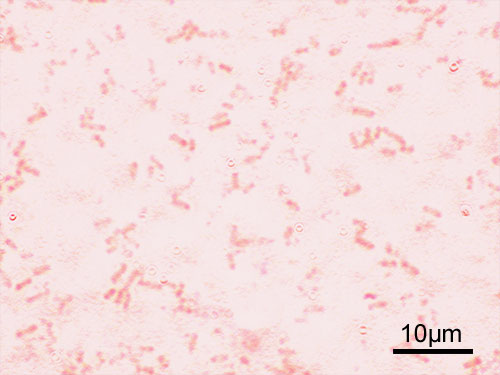
| Gram staining properties | Negative |
| Shape | Rod |
| Mobility | No |
| Flagellar presence | Yes |
| Number of membranes | 2 |

Image source: Wikipedia/Wikimedia
| Ecology, Host, and Life Cycle | |
|---|---|
| Oxygen requirements | Facultative anaerobe |
| Optimal temperature | 37 |
| Temperature range | Mesophilic |
| Habitat | HostAssociated |
| Biotic relationship | Free living |
| Host(s) | Homo sapiens, Metazoa, Primates |
| Cell arrangement | Pairs - Singles |
| Sporulation | Not Available |
| Energy source | Chemoorganotroph |
| Pathogenicity | Not Available |
Gene Summary
Adenine Count
1232144 bp
Thymine Count
1216307 bp
Guanine Count
1250889 bp
Cytosine Count
1272262 bp
Genome Length
4982938 bp
Protein-coding Genes
4744 genes
Non-Coding Genes
267 genes
# of Chromosomes/Plasmids
3
Genes
| Name | Locus Tag | UniProt ID | Strand Orientation | Gene Start/End | Protein Molecular Weight |
|---|---|---|---|---|---|
| Is1 transposase b | NCTC4837_04068 | Not Available | Negative | 3378792 - 3379007 | 8498.39 |
| Is2 transposase tnpb | NCTC4837_04069 | Not Available | Negative | 3379229 - 3380134 | 34400.0 |
| Isrso10-transposase orfa protein | NCTC4837_04070 | Not Available | Negative | 3380092 - 3380457 | 13452.4 |
| Transposase is1 | NCTC4837_04071 | Not Available | Negative | 3380549 - 3380821 | 10348.5 |
| prophage protein | NCTC4837_04072 | Not Available | Negative | 3381185 - 3381841 | 24016.8 |
| Attr | Not Available | Not Available | Positive | 3382557 - 3382587 | Not Available |
| Integrase protein | NCTC4837_04074 | Not Available | Negative | 3382673 - 3383356 | 25712.7 |
| Putative integrase | NCTC4837_04075 | Not Available | Negative | 3383313 - 3383690 | 14705.4 |
| Transposase is1 | NCTC4837_04076 | Not Available | Positive | 3383767 - 3384039 | 10378.5 |
| Is1 transposase b | NCTC4837_04077 | Not Available | Positive | 3384066 - 3384461 | 15364.6 |
Pathways
0 pathways
No pathways found
No metabolic pathways have been associated with this bacterium yet.
Health Effects
| Health Condition | Relation | Reference |
|---|---|---|
| Shigellosis | Causes | PMC5177732 |
| Hus | Causes | PMC7320338 |
| Shigellosis | Causes | PMC8742002 |
| Bacillary dysentery | Causes | PMC8742002 |
| Bacillary dysentery | Causes | PMC11098424 |
| Bacillary dysentery | Causes | PMC11143797 |
| Shigellosis | Causes | PMC11143797 |
| Epidemic shigella dysentery | Causes | PMC4445032 |