Kingdom
Pseudomonadati
Phylum
Pseudomonadota
Class
Gammaproteobacteria
Order
Enterobacterales
Family
Enterobacteriaceae
Genus
Shigella
Description
Taxonomy
| Kingdom | Pseudomonadati |
|---|---|
| Phylum | Pseudomonadota |
| Class | Gammaproteobacteria |
| Order | Enterobacterales |
| Family | Enterobacteriaceae |
| Genus | Shigella |
| Species | Shigella dysenteriae |
| Strain | No strain |
Profile
| Physiology | |
|---|---|
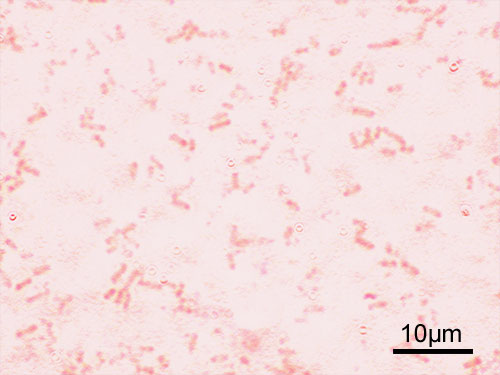
| Gram staining properties | Negative |
| Shape | Rod |
| Mobility | No |
| Flagellar presence | Yes |
| Number of membranes | 2 |

Image source: Wikipedia/Wikimedia
| Ecology, Host, and Life Cycle | |
|---|---|
| Oxygen requirements | Facultative anaerobe |
| Optimal temperature | 37 |
| Temperature range | Mesophilic |
| Habitat | HostAssociated |
| Biotic relationship | Free living |
| Host(s) | Homo sapiens, Metazoa, Primates |
| Cell arrangement | Pairs - Singles |
| Sporulation | Not Available |
| Energy source | Chemoorganotroph |
| Pathogenicity | Not Available |
Gene Summary
Adenine Count
1232144 bp
Thymine Count
1216307 bp
Guanine Count
1250889 bp
Cytosine Count
1272262 bp
Genome Length
4982938 bp
Protein-coding Genes
4744 genes
Non-Coding Genes
267 genes
# of Chromosomes/Plasmids
3
Genes
| Name | Locus Tag | UniProt ID | Strand Orientation | Gene Start/End | Protein Molecular Weight |
|---|---|---|---|---|---|
| peptide antibiotic transporter sbma | DL723_23845 | Not Available | Negative | 4628632 - 4629852 | 46461.9 |
| hypothetical protein | DL723_23850 | Not Available | Negative | 4629872 - 4630066 | 7219.09 |
| d-alanyl-d-alanine- carboxypeptidase/endopeptidase amph | DL723_23855 | Not Available | Positive | 4630204 - 4631361 | 41851.5 |
| hydrogen peroxide resistance inhibitor ipra | DL723_23860 | Not Available | Negative | 4631362 - 4631985 | 23904.0 |
| autotransporter outer membrane beta-barrel domain-containing protein | DL723_23865 | Not Available | Negative | 4632073 - 4634331 | 80073.4 |
| hypothetical protein | DL723_23870 | Not Available | Negative | 4634332 - 4634899 | 21198.1 |
| Trna-asp | Not Available | Not Available | Positive | 4635227 - 4635303 | Not Available |
| hypothetical protein | DL723_23880 | Not Available | Positive | 4635317 - 4635496 | 6825.48 |
| dna polymerase iii subunit epsilon | DL723_23885 | Not Available | Negative | 4635436 - 4636167 | 27100.5 |
| ribonuclease hi | DL723_23890 | Not Available | Positive | 4636232 - 4636699 | 17597.9 |
Pathways
0 pathways
No pathways found
No metabolic pathways have been associated with this bacterium yet.
Health Effects
| Health Condition | Relation | Reference |
|---|---|---|
| Shigellosis | Causes | PMC5177732 |
| Hus | Causes | PMC7320338 |
| Shigellosis | Causes | PMC8742002 |
| Bacillary dysentery | Causes | PMC8742002 |
| Bacillary dysentery | Causes | PMC11098424 |
| Bacillary dysentery | Causes | PMC11143797 |
| Shigellosis | Causes | PMC11143797 |
| Epidemic shigella dysentery | Causes | PMC4445032 |