Kingdom
Pseudomonadati
Phylum
Pseudomonadota
Class
Gammaproteobacteria
Order
Enterobacterales
Family
Enterobacteriaceae
Genus
Shigella
Description
Taxonomy
| Kingdom | Pseudomonadati |
|---|---|
| Phylum | Pseudomonadota |
| Class | Gammaproteobacteria |
| Order | Enterobacterales |
| Family | Enterobacteriaceae |
| Genus | Shigella |
| Species | Shigella dysenteriae |
| Strain | No strain |
Profile
| Physiology | |
|---|---|
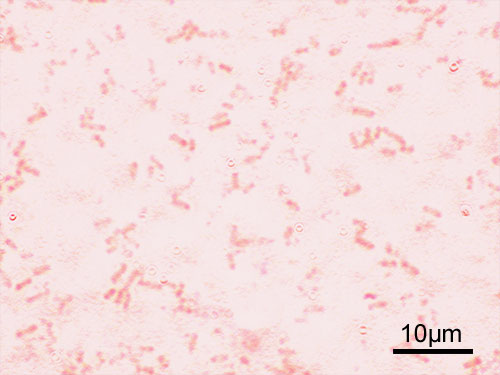
| Gram staining properties | Negative |
| Shape | Rod |
| Mobility | No |
| Flagellar presence | Yes |
| Number of membranes | 2 |

Image source: Wikipedia/Wikimedia
| Ecology, Host, and Life Cycle | |
|---|---|
| Oxygen requirements | Facultative anaerobe |
| Optimal temperature | 37 |
| Temperature range | Mesophilic |
| Habitat | HostAssociated |
| Biotic relationship | Free living |
| Host(s) | Homo sapiens, Metazoa, Primates |
| Cell arrangement | Pairs - Singles |
| Sporulation | Not Available |
| Energy source | Chemoorganotroph |
| Pathogenicity | Not Available |
Gene Summary
Adenine Count
1232144 bp
Thymine Count
1216307 bp
Guanine Count
1250889 bp
Cytosine Count
1272262 bp
Genome Length
4982938 bp
Protein-coding Genes
4744 genes
Non-Coding Genes
267 genes
# of Chromosomes/Plasmids
3
Genes
| Name | Locus Tag | UniProt ID | Strand Orientation | Gene Start/End | Protein Molecular Weight |
|---|---|---|---|---|---|
| 50s ribosomal protein l18 | DL723_20410 | Not Available | Positive | 3973572 - 3973925 | 12770.4 |
| 30s ribosomal protein s5 | DL723_20415 | Not Available | Positive | 3973940 - 3974443 | 17604.5 |
| 50s ribosomal protein l30 | DL723_20420 | Not Available | Positive | 3974447 - 3974626 | 6542.23 |
| 50s ribosomal protein l15 | DL723_20425 | Not Available | Positive | 3974630 - 3975064 | 14967.4 |
| protein translocase subunit secy | DL723_20430 | Not Available | Positive | 3975072 - 3976403 | 48514.7 |
| 50s ribosomal protein l36 | DL723_20435 | Not Available | Positive | 3976435 - 3976551 | 4364.59 |
| 30s ribosomal protein s13 | DL723_20440 | Not Available | Positive | 3976698 - 3977054 | 13100.2 |
| 30s ribosomal protein s11 | DL723_20445 | Not Available | Positive | 3977071 - 3977460 | 13845.7 |
| 30s ribosomal protein s4 | DL723_20450 | Not Available | Positive | 3977494 - 3978114 | 23470.5 |
| dna-directed rna polymerase subunit alpha | DL723_20455 | Not Available | Positive | 3978140 - 3979129 | 36513.9 |
Pathways
0 pathways
No pathways found
No metabolic pathways have been associated with this bacterium yet.
Health Effects
| Health Condition | Relation | Reference |
|---|---|---|
| Shigellosis | Causes | PMC5177732 |
| Hus | Causes | PMC7320338 |
| Shigellosis | Causes | PMC8742002 |
| Bacillary dysentery | Causes | PMC8742002 |
| Bacillary dysentery | Causes | PMC11098424 |
| Bacillary dysentery | Causes | PMC11143797 |
| Shigellosis | Causes | PMC11143797 |
| Epidemic shigella dysentery | Causes | PMC4445032 |