Kingdom
Pseudomonadati
Phylum
Pseudomonadota
Class
Gammaproteobacteria
Order
Enterobacterales
Family
Enterobacteriaceae
Genus
Salmonella
Description
Taxonomy
| Kingdom | Pseudomonadati |
|---|---|
| Phylum | Pseudomonadota |
| Class | Gammaproteobacteria |
| Order | Enterobacterales |
| Family | Enterobacteriaceae |
| Genus | Salmonella |
| Species | Salmonella enterica |
| Strain | subsp. enterica serovar Heidelberg |
Profile
| Physiology | |
|---|---|
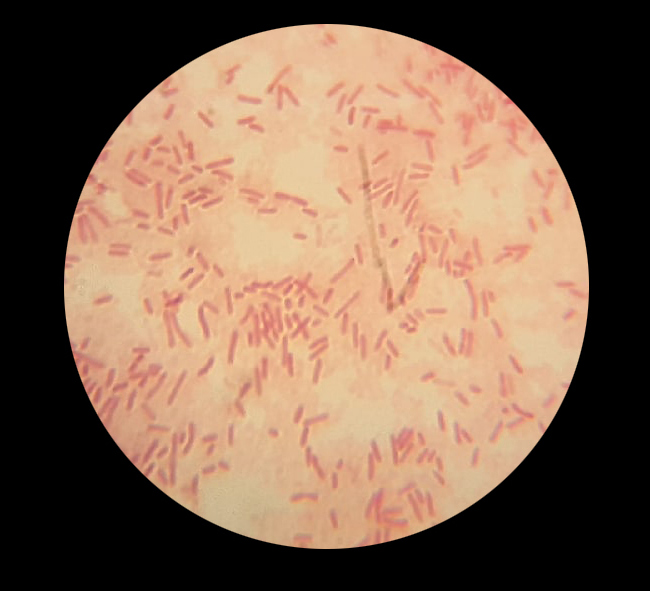
| Gram staining properties | Negative |
| Shape | Spirilla |
| Mobility | No |
| Flagellar presence | Yes |
| Number of membranes | 2 |

Image source: Wikipedia/Wikimedia
| Ecology, Host, and Life Cycle | |
|---|---|
| Oxygen requirements | Microaerophilic |
| Optimal temperature | 37 |
| Temperature range | Mesophilic |
| Habitat | HostAssociated |
| Biotic relationship | Free living |
| Host(s) | Not Available |
| Cell arrangement | Chains - Singles |
| Sporulation | Not Available |
| Energy source | Chemoorganotroph |
| Pathogenicity | Not Available |
Gene Summary
Adenine Count
1180452 bp
Thymine Count
1177655 bp
Guanine Count
1268707 bp
Cytosine Count
1268362 bp
Genome Length
4895176 bp
Protein-coding Genes
4608 genes
Non-Coding Genes
302 genes
# of Chromosomes/Plasmids
1
Genes
| Name | Locus Tag | UniProt ID | Strand Orientation | Gene Start/End | Protein Molecular Weight |
|---|---|---|---|---|---|
| hypothetical protein | FGD25_24640 | Not Available | Negative | 4826519 - 4826755 | 8902.85 |
| fimbriae biosynthesis transcriptional regulator fimw | FGD25_24645 | Not Available | Positive | 4826711 - 4827307 | 23396.8 |
| diguanylate cyclase | FGD25_24650 | Not Available | Positive | 4827469 - 4827780 | 11596.9 |
| fimbriae biosynthesis regulator fimy | FGD25_24655 | Not Available | Positive | 4827799 - 4828521 | 27839.9 |
| hypothetical protein | FGD25_24660 | Not Available | Negative | 4828540 - 4828894 | 13827.6 |
| hypothetical protein | FGD25_24665 | Not Available | Positive | 4828895 - 4829364 | 17076.1 |
| mota/tolq/exbb proton channel family protein | FGD25_24670 | Not Available | Positive | 4829361 - 4830749 | 51513.1 |
| tolc family protein | FGD25_24675 | Not Available | Positive | 4830739 - 4831995 | 48175.2 |
| 3-deoxy-d-manno-oct-2-ulosonate iii transferase waaz | FGD25_24680 | Not Available | Positive | 4831996 - 4832335 | 12820.0 |
| spi-2 type iii secretion system effector pipb | FGD25_24690 | Not Available | Positive | 4833276 - 4834151 | 31807.0 |
Pathways
0 pathways
No pathways found
No metabolic pathways have been associated with this bacterium yet.
Health Effects
No health effects information available for this bacterium.