Kingdom
Pseudomonadati
Phylum
Pseudomonadota
Class
Gammaproteobacteria
Order
Enterobacterales
Family
Enterobacteriaceae
Genus
Salmonella
Description
Taxonomy
| Kingdom | Pseudomonadati |
|---|---|
| Phylum | Pseudomonadota |
| Class | Gammaproteobacteria |
| Order | Enterobacterales |
| Family | Enterobacteriaceae |
| Genus | Salmonella |
| Species | Salmonella enterica |
| Strain | subsp. enterica serovar Heidelberg |
Profile
| Physiology | |
|---|---|
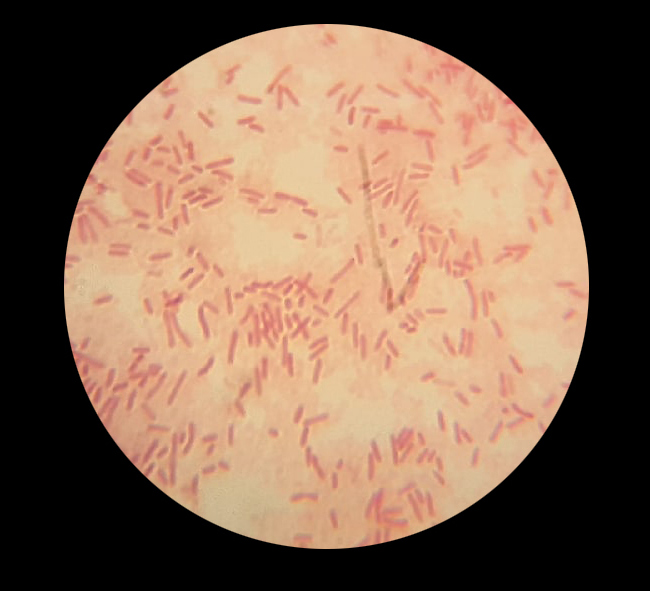
| Gram staining properties | Negative |
| Shape | Spirilla |
| Mobility | No |
| Flagellar presence | Yes |
| Number of membranes | 2 |

Image source: Wikipedia/Wikimedia
| Ecology, Host, and Life Cycle | |
|---|---|
| Oxygen requirements | Microaerophilic |
| Optimal temperature | 37 |
| Temperature range | Mesophilic |
| Habitat | HostAssociated |
| Biotic relationship | Free living |
| Host(s) | Not Available |
| Cell arrangement | Chains - Singles |
| Sporulation | Not Available |
| Energy source | Chemoorganotroph |
| Pathogenicity | Not Available |
Gene Summary
Adenine Count
1180452 bp
Thymine Count
1177655 bp
Guanine Count
1268707 bp
Cytosine Count
1268362 bp
Genome Length
4895176 bp
Protein-coding Genes
4608 genes
Non-Coding Genes
302 genes
# of Chromosomes/Plasmids
1
Genes
| Name | Locus Tag | UniProt ID | Strand Orientation | Gene Start/End | Protein Molecular Weight |
|---|---|---|---|---|---|
| flagellar hook-filament junction protein flgl | FGD25_10600 | Not Available | Negative | 2124688 - 2125641 | 34178.1 |
| flagellar hook-associated protein flgk | FGD25_10605 | Not Available | Negative | 2125656 - 2127317 | 59112.6 |
| flagellar assembly peptidoglycan hydrolase flgj | FGD25_10610 | Not Available | Negative | 2127382 - 2128332 | 34387.0 |
| flagellar basal body p-ring protein flgi | FGD25_10615 | Not Available | Negative | 2128332 - 2129429 | 38170.9 |
| flagellar basal body l-ring protein flgh | FGD25_10620 | Not Available | Negative | 2129441 - 2130139 | 24710.2 |
| flagellar basal body rod protein flgg | FGD25_10625 | Not Available | Negative | 2130194 - 2130976 | 27771.7 |
| flagellar basal body rod protein flgf | FGD25_10630 | Not Available | Negative | 2130990 - 2131745 | 26103.9 |
| flagellar hook protein flge | FGD25_10635 | Not Available | Negative | 2131766 - 2132977 | 42078.7 |
| flagellar hook assembly protein flgd | FGD25_10640 | Not Available | Negative | 2133004 - 2133702 | 23989.3 |
| flagellar basal body rod protein flgc | FGD25_10645 | Not Available | Negative | 2133714 - 2134118 | 13982.8 |
Pathways
0 pathways
No pathways found
No metabolic pathways have been associated with this bacterium yet.
Health Effects
No health effects information available for this bacterium.