Kingdom
Pseudomonadati
Phylum
Pseudomonadota
Class
Gammaproteobacteria
Order
Enterobacterales
Family
Enterobacteriaceae
Genus
Salmonella
Description
Taxonomy
| Kingdom | Pseudomonadati |
|---|---|
| Phylum | Pseudomonadota |
| Class | Gammaproteobacteria |
| Order | Enterobacterales |
| Family | Enterobacteriaceae |
| Genus | Salmonella |
| Species | Salmonella enterica |
| Strain | subsp. enterica serovar Heidelberg |
Profile
| Physiology | |
|---|---|
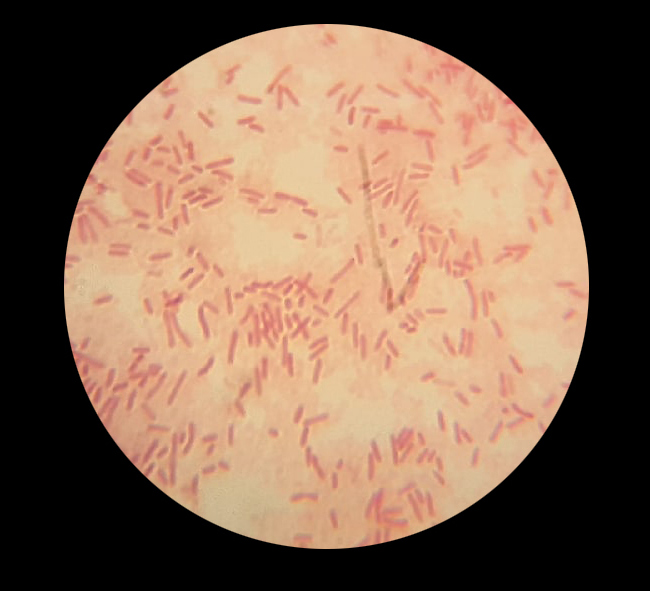
| Gram staining properties | Negative |
| Shape | Spirilla |
| Mobility | No |
| Flagellar presence | Yes |
| Number of membranes | 2 |

Image source: Wikipedia/Wikimedia
| Ecology, Host, and Life Cycle | |
|---|---|
| Oxygen requirements | Microaerophilic |
| Optimal temperature | 37 |
| Temperature range | Mesophilic |
| Habitat | HostAssociated |
| Biotic relationship | Free living |
| Host(s) | Not Available |
| Cell arrangement | Chains - Singles |
| Sporulation | Not Available |
| Energy source | Chemoorganotroph |
| Pathogenicity | Not Available |
Gene Summary
Adenine Count
1180452 bp
Thymine Count
1177655 bp
Guanine Count
1268707 bp
Cytosine Count
1268362 bp
Genome Length
4895176 bp
Protein-coding Genes
4608 genes
Non-Coding Genes
302 genes
# of Chromosomes/Plasmids
1
Genes
| Name | Locus Tag | UniProt ID | Strand Orientation | Gene Start/End | Protein Molecular Weight |
|---|---|---|---|---|---|
| imidazole glycerol phosphate synthase subunit hisf | FGD25_10400 | Not Available | Negative | 2084549 - 2085325 | 28369.9 |
| 1-(5-phosphoribosyl)-5-((5- phosphoribosylamino)methylideneamino)imidazole-4- carboxamide isomerase | FGD25_10405 | Not Available | Negative | 2085307 - 2086044 | 26090.4 |
| imidazole glycerol phosphate synthase subunit hish | FGD25_10410 | Not Available | Negative | 2086044 - 2086634 | 21705.3 |
| bifunctional histidinol-phosphatase/imidazoleglycerol-phosphate dehydratase hisb | FGD25_10415 | Not Available | Negative | 2086634 - 2087701 | 40185.2 |
| histidinol-phosphate transaminase | FGD25_10420 | Not Available | Negative | 2087698 - 2088777 | 39717.6 |
| histidinol dehydrogenase | FGD25_10425 | Not Available | Negative | 2088774 - 2090078 | 45891.4 |
| atp phosphoribosyltransferase | FGD25_10430 | Not Available | Negative | 2090181 - 2091080 | 33213.7 |
| his operon leader peptide | FGD25_10435 | Not Available | Negative | 2091227 - 2091277 | 2081.43 |
| sdr family oxidoreductase | FGD25_10440 | Not Available | Positive | 2091440 - 2092264 | 29663.9 |
| lysr family transcriptional regulator | FGD25_10445 | Not Available | Positive | 2092310 - 2093224 | 33751.8 |
Pathways
0 pathways
No pathways found
No metabolic pathways have been associated with this bacterium yet.
Health Effects
No health effects information available for this bacterium.