Kingdom
Pseudomonadati
Phylum
Pseudomonadota
Class
Gammaproteobacteria
Order
Enterobacterales
Family
Enterobacteriaceae
Genus
Salmonella
Description
Taxonomy
| Kingdom | Pseudomonadati |
|---|---|
| Phylum | Pseudomonadota |
| Class | Gammaproteobacteria |
| Order | Enterobacterales |
| Family | Enterobacteriaceae |
| Genus | Salmonella |
| Species | Salmonella enterica |
| Strain | subsp. enterica serovar Heidelberg |
Profile
| Physiology | |
|---|---|
| Gram staining properties | Negative |
| Shape | Spirilla |
| Mobility | No |
| Flagellar presence | Yes |
| Number of membranes | 2 |

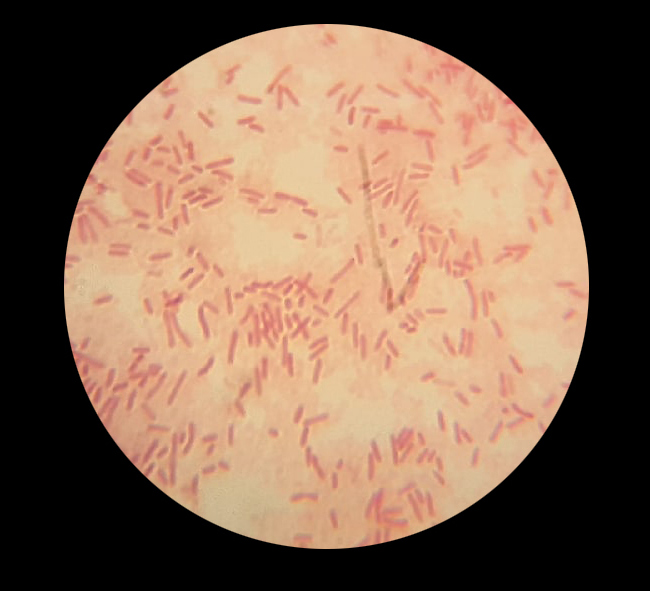
Image source: Wikipedia/Wikimedia
| Ecology, Host, and Life Cycle | |
|---|---|
| Oxygen requirements | Microaerophilic |
| Optimal temperature | 37 |
| Temperature range | Mesophilic |
| Habitat | HostAssociated |
| Biotic relationship | Free living |
| Host(s) | Not Available |
| Cell arrangement | Chains - Singles |
| Sporulation | Not Available |
| Energy source | Chemoorganotroph |
| Pathogenicity | Not Available |
Gene Summary
Adenine Count
1180452 bp
Thymine Count
1177655 bp
Guanine Count
1268707 bp
Cytosine Count
1268362 bp
Genome Length
4895176 bp
Protein-coding Genes
4608 genes
Non-Coding Genes
302 genes
# of Chromosomes/Plasmids
1
Genes
| Name | Locus Tag | UniProt ID | Strand Orientation | Gene Start/End | Protein Molecular Weight |
|---|---|---|---|---|---|
| trna (adenosine(37)-n6)-dimethylallyltransferase miaa | FGD25_09370 | Not Available | Negative | 1870201 - 1871151 | 35188.4 |
| dna mismatch repair endonuclease mutl | FGD25_09375 | Not Available | Negative | 1871144 - 1873000 | 67751.3 |
| n-acetylmuramoyl-l-alanine amidase amib | FGD25_09380 | Not Available | Negative | 1873010 - 1874332 | 46889.4 |
| trna (adenosine(37)-n6)-threonylcarbamoyltransferase complex atpase subunit type 1 tsae | FGD25_09385 | Not Available | Negative | 1874349 - 1874810 | 16896.0 |
| bifunctional adp-dependent nad(p)h-hydrate dehydratase/nad(p)h-hydrate epimerase | FGD25_09390 | Not Available | Negative | 1874782 - 1876329 | 54282.3 |
| trna epoxyqueuosine(34) reductase queg | FGD25_09395 | Not Available | Positive | 1876313 - 1877467 | 43380.7 |
| Trna-gly | Not Available | Not Available | Positive | 1877737 - 1877812 | Not Available |
| Trna-gly | Not Available | Not Available | Positive | 1877969 - 1878044 | Not Available |
| Trna-gly | Not Available | Not Available | Positive | 1878201 - 1878276 | Not Available |
| transporter substrate-binding domain-containing protein | FGD25_09415 | Not Available | Positive | 1878552 - 1879292 | 27351.5 |
Pathways
0 pathways
No pathways found
No metabolic pathways have been associated with this bacterium yet.
Health Effects
No health effects information available for this bacterium.