Kingdom
Pseudomonadati
Phylum
Pseudomonadota
Class
Gammaproteobacteria
Order
Enterobacterales
Family
Enterobacteriaceae
Genus
Salmonella
Description
Taxonomy
| Kingdom | Pseudomonadati |
|---|---|
| Phylum | Pseudomonadota |
| Class | Gammaproteobacteria |
| Order | Enterobacterales |
| Family | Enterobacteriaceae |
| Genus | Salmonella |
| Species | Salmonella enterica |
| Strain | subsp. enterica serovar Heidelberg |
Profile
| Physiology | |
|---|---|
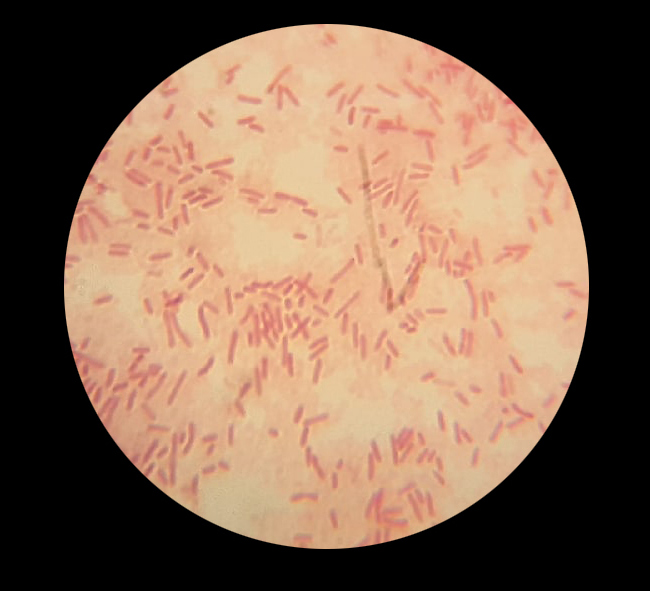
| Gram staining properties | Negative |
| Shape | Spirilla |
| Mobility | No |
| Flagellar presence | Yes |
| Number of membranes | 2 |

Image source: Wikipedia/Wikimedia
| Ecology, Host, and Life Cycle | |
|---|---|
| Oxygen requirements | Microaerophilic |
| Optimal temperature | 37 |
| Temperature range | Mesophilic |
| Habitat | HostAssociated |
| Biotic relationship | Free living |
| Host(s) | Not Available |
| Cell arrangement | Chains - Singles |
| Sporulation | Not Available |
| Energy source | Chemoorganotroph |
| Pathogenicity | Not Available |
Gene Summary
Adenine Count
1180452 bp
Thymine Count
1177655 bp
Guanine Count
1268707 bp
Cytosine Count
1268362 bp
Genome Length
4895176 bp
Protein-coding Genes
4608 genes
Non-Coding Genes
302 genes
# of Chromosomes/Plasmids
1
Genes
| Name | Locus Tag | UniProt ID | Strand Orientation | Gene Start/End | Protein Molecular Weight |
|---|---|---|---|---|---|
| cellulase | FGD25_08305 | Not Available | Positive | 1638660 - 1639769 | 41716.7 |
| cellulose biosynthesis protein bcsc | FGD25_08310 | Not Available | Positive | 1639751 - 1643293 | 129852.0 |
| biofilm formation regulator hmsp | FGD25_08315 | Not Available | Positive | 1643467 - 1645473 | 75289.4 |
| dicarboxylate/amino acid:cation symporter | FGD25_08320 | Not Available | Positive | 1645631 - 1646917 | 45452.1 |
| insulinase family protein | FGD25_08325 | Not Available | Positive | 1647137 - 1648624 | 55183.8 |
| sugar kinase | FGD25_08330 | Not Available | Negative | 1648678 - 1649607 | 34070.4 |
| cyclic-guanylate-specific phosphodiesterase | FGD25_08335 | Not Available | Positive | 1649836 - 1650603 | 29778.2 |
| asma family protein | FGD25_08340 | Not Available | Positive | 1650713 - 1652773 | 74710.1 |
| mhs family mfs transporter | FGD25_08345 | Not Available | Negative | 1652813 - 1654135 | 47155.9 |
| inner membrane protein yhjd | FGD25_08350 | Not Available | Negative | 1654486 - 1655514 | 38732.7 |
Pathways
0 pathways
No pathways found
No metabolic pathways have been associated with this bacterium yet.
Health Effects
No health effects information available for this bacterium.