Kingdom
Pseudomonadati
Phylum
Pseudomonadota
Class
Gammaproteobacteria
Order
Enterobacterales
Family
Enterobacteriaceae
Genus
Salmonella
Description
Taxonomy
| Kingdom | Pseudomonadati |
|---|---|
| Phylum | Pseudomonadota |
| Class | Gammaproteobacteria |
| Order | Enterobacterales |
| Family | Enterobacteriaceae |
| Genus | Salmonella |
| Species | Salmonella enterica |
| Strain | subsp. enterica serovar Heidelberg |
Profile
| Physiology | |
|---|---|
| Gram staining properties | Negative |
| Shape | Spirilla |
| Mobility | No |
| Flagellar presence | Yes |
| Number of membranes | 2 |

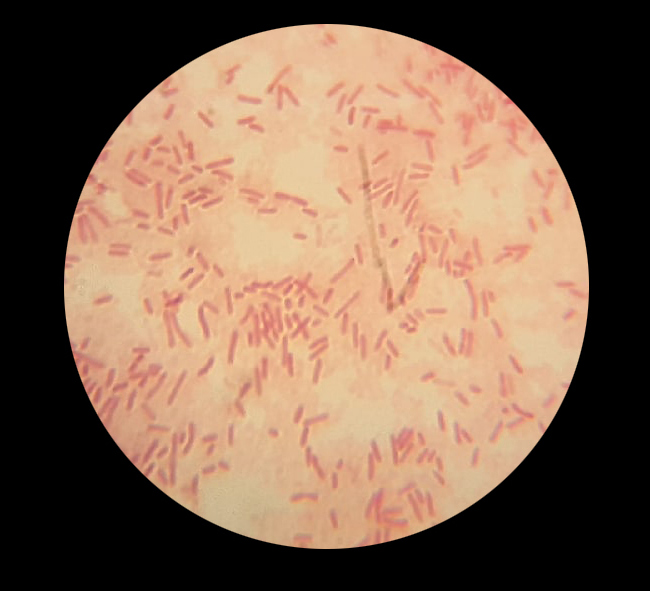
Image source: Wikipedia/Wikimedia
| Ecology, Host, and Life Cycle | |
|---|---|
| Oxygen requirements | Microaerophilic |
| Optimal temperature | 37 |
| Temperature range | Mesophilic |
| Habitat | HostAssociated |
| Biotic relationship | Free living |
| Host(s) | Not Available |
| Cell arrangement | Chains - Singles |
| Sporulation | Not Available |
| Energy source | Chemoorganotroph |
| Pathogenicity | Not Available |
Gene Summary
Adenine Count
1180452 bp
Thymine Count
1177655 bp
Guanine Count
1268707 bp
Cytosine Count
1268362 bp
Genome Length
4895176 bp
Protein-coding Genes
4608 genes
Non-Coding Genes
302 genes
# of Chromosomes/Plasmids
1
Genes
| Name | Locus Tag | UniProt ID | Strand Orientation | Gene Start/End | Protein Molecular Weight |
|---|---|---|---|---|---|
| rpoe-regulated lipoprotein | FGD25_06665 | Not Available | Positive | 1309789 - 1310364 | 20555.2 |
| porphyrinogen peroxidase | FGD25_06670 | Not Available | Positive | 1310459 - 1311358 | 33050.2 |
| sdr family oxidoreductase ucpa | FGD25_06675 | Not Available | Positive | 1311597 - 1312388 | 27871.4 |
| sulfate abc transporter substrate-binding protein | FGD25_06680 | Not Available | Positive | 1312546 - 1313562 | 37570.6 |
| sulfate/thiosulfate abc transporter permease cyst | FGD25_06685 | Not Available | Positive | 1313562 - 1314395 | 30200.5 |
| sulfate/thiosulfate abc transporter permease cysw | FGD25_06690 | Not Available | Positive | 1314395 - 1315270 | 32529.6 |
| sulfate/thiosulfate abc transporter atp-binding protein cysa | FGD25_06695 | Not Available | Positive | 1315260 - 1316357 | 41037.5 |
| cysteine synthase b | FGD25_06700 | Not Available | Positive | 1316425 - 1317336 | 32647.2 |
| sel1 repeat family protein | FGD25_06705 | Not Available | Positive | 1317588 - 1318196 | 23149.1 |
| hypothetical protein | FGD25_06710 | Not Available | Negative | 1318296 - 1318679 | 13998.0 |
Pathways
0 pathways
No pathways found
No metabolic pathways have been associated with this bacterium yet.
Health Effects
No health effects information available for this bacterium.