Kingdom
Pseudomonadati
Phylum
Pseudomonadota
Class
Gammaproteobacteria
Order
Enterobacterales
Family
Enterobacteriaceae
Genus
Salmonella
Description
Taxonomy
| Kingdom | Pseudomonadati |
|---|---|
| Phylum | Pseudomonadota |
| Class | Gammaproteobacteria |
| Order | Enterobacterales |
| Family | Enterobacteriaceae |
| Genus | Salmonella |
| Species | Salmonella enterica |
| Strain | subsp. enterica serovar Heidelberg |
Profile
| Physiology | |
|---|---|
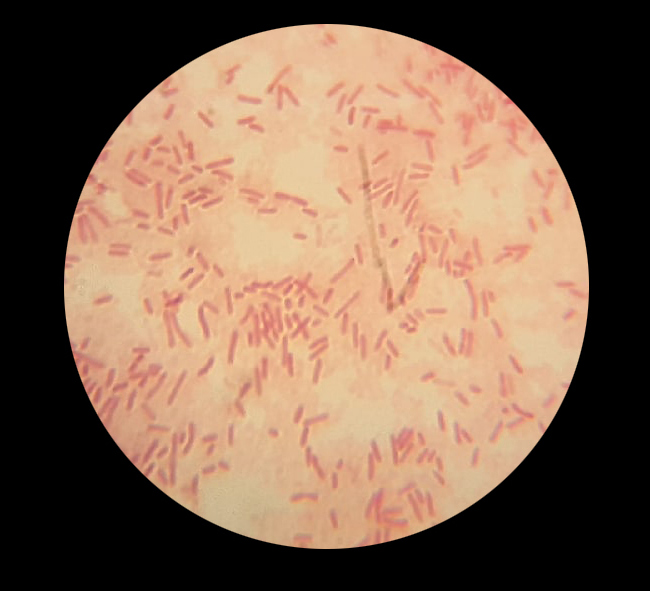
| Gram staining properties | Negative |
| Shape | Spirilla |
| Mobility | No |
| Flagellar presence | Yes |
| Number of membranes | 2 |

Image source: Wikipedia/Wikimedia
| Ecology, Host, and Life Cycle | |
|---|---|
| Oxygen requirements | Microaerophilic |
| Optimal temperature | 37 |
| Temperature range | Mesophilic |
| Habitat | HostAssociated |
| Biotic relationship | Free living |
| Host(s) | Not Available |
| Cell arrangement | Chains - Singles |
| Sporulation | Not Available |
| Energy source | Chemoorganotroph |
| Pathogenicity | Not Available |
Gene Summary
Adenine Count
1180452 bp
Thymine Count
1177655 bp
Guanine Count
1268707 bp
Cytosine Count
1268362 bp
Genome Length
4895176 bp
Protein-coding Genes
4608 genes
Non-Coding Genes
302 genes
# of Chromosomes/Plasmids
1
Genes
| Name | Locus Tag | UniProt ID | Strand Orientation | Gene Start/End | Protein Molecular Weight |
|---|---|---|---|---|---|
| glutamine-hydrolyzing gmp synthase | FGD25_06355 | Not Available | Positive | 1246158 - 1247735 | 58689.6 |
| duf1493 family protein | FGD25_06365 | Not Available | Negative | 1248268 - 1248597 | 12954.4 |
| duf2633 family protein | FGD25_06375 | Not Available | Negative | 1249293 - 1249484 | 7447.0 |
| hypothetical protein | FGD25_06380 | Not Available | Positive | 1249663 - 1249800 | 5434.78 |
| sensor domain-containing phosphodiesterase | FGD25_06385 | Not Available | Positive | 1249897 - 1252110 | 84291.4 |
| exopolyphosphatase | FGD25_06390 | Not Available | Negative | 1252146 - 1253687 | 58148.3 |
| polyphosphate kinase 1 | FGD25_06395 | Not Available | Negative | 1253692 - 1255758 | 80461.1 |
| phosphoribosylglycinamide formyltransferase | FGD25_06400 | Not Available | Negative | 1255947 - 1256585 | 23512.0 |
| phosphoribosylformylglycinamidine cyclo-ligase | FGD25_06405 | Not Available | Negative | 1256585 - 1257622 | 36902.3 |
| hypothetical protein | FGD25_06410 | Not Available | Negative | 1257658 - 1257837 | 7043.7 |
Pathways
0 pathways
No pathways found
No metabolic pathways have been associated with this bacterium yet.
Health Effects
No health effects information available for this bacterium.