Kingdom
Pseudomonadati
Phylum
Pseudomonadota
Class
Gammaproteobacteria
Order
Enterobacterales
Family
Enterobacteriaceae
Genus
Salmonella
Description
Taxonomy
| Kingdom | Pseudomonadati |
|---|---|
| Phylum | Pseudomonadota |
| Class | Gammaproteobacteria |
| Order | Enterobacterales |
| Family | Enterobacteriaceae |
| Genus | Salmonella |
| Species | Salmonella enterica |
| Strain | subsp. enterica serovar Heidelberg |
Profile
| Physiology | |
|---|---|
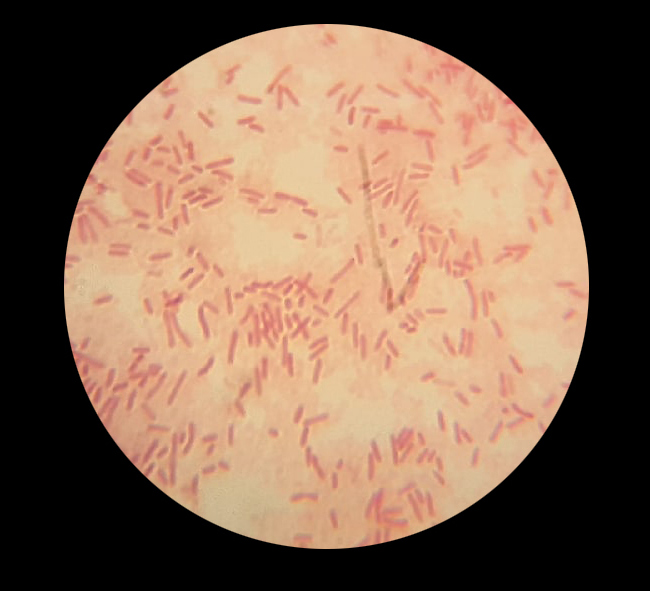
| Gram staining properties | Negative |
| Shape | Spirilla |
| Mobility | No |
| Flagellar presence | Yes |
| Number of membranes | 2 |

Image source: Wikipedia/Wikimedia
| Ecology, Host, and Life Cycle | |
|---|---|
| Oxygen requirements | Microaerophilic |
| Optimal temperature | 37 |
| Temperature range | Mesophilic |
| Habitat | HostAssociated |
| Biotic relationship | Free living |
| Host(s) | Not Available |
| Cell arrangement | Chains - Singles |
| Sporulation | Not Available |
| Energy source | Chemoorganotroph |
| Pathogenicity | Not Available |
Gene Summary
Adenine Count
1180452 bp
Thymine Count
1177655 bp
Guanine Count
1268707 bp
Cytosine Count
1268362 bp
Genome Length
4895176 bp
Protein-coding Genes
4608 genes
Non-Coding Genes
302 genes
# of Chromosomes/Plasmids
1
Genes
| Name | Locus Tag | UniProt ID | Strand Orientation | Gene Start/End | Protein Molecular Weight |
|---|---|---|---|---|---|
| chaperone sicp | FGD25_05470 | Not Available | Negative | 1061602 - 1061994 | 14468.4 |
| hypothetical protein | FGD25_05475 | Not Available | Negative | 1062021 - 1062281 | 10057.5 |
| acyl carrier protein | FGD25_05480 | Not Available | Negative | 1062325 - 1062573 | 9168.91 |
| spi-1 type iii secretion system effector sipa | FGD25_05485 | Not Available | Negative | 1062592 - 1064649 | 73976.0 |
| spi-1 type iii secretion system needle tip complex protein sipd | FGD25_05490 | Not Available | Negative | 1064668 - 1065699 | 37105.3 |
| spi-1 type iii secretion system needle tip complex protein sipc | FGD25_05495 | Not Available | Negative | 1065770 - 1066999 | 42985.9 |
| spi-1 type iii secretion system needle tip complex protein sipb | FGD25_05500 | Not Available | Negative | 1067027 - 1068808 | 62454.4 |
| type iii secretion system translocator chaperone sica | FGD25_05505 | Not Available | Negative | 1068811 - 1069308 | 19221.7 |
| spi-1 type iii secretion system export apparatus protein spas | FGD25_05510 | Not Available | Negative | 1069446 - 1070516 | 40095.8 |
| spi-1 type iii secretion system export apparatus protein spar | FGD25_05515 | Not Available | Negative | 1070503 - 1071294 | 28488.4 |
Pathways
0 pathways
No pathways found
No metabolic pathways have been associated with this bacterium yet.
Health Effects
No health effects information available for this bacterium.