Kingdom
Pseudomonadati
Phylum
Pseudomonadota
Class
Gammaproteobacteria
Order
Enterobacterales
Family
Enterobacteriaceae
Genus
Salmonella
Description
Taxonomy
| Kingdom | Pseudomonadati |
|---|---|
| Phylum | Pseudomonadota |
| Class | Gammaproteobacteria |
| Order | Enterobacterales |
| Family | Enterobacteriaceae |
| Genus | Salmonella |
| Species | Salmonella enterica |
| Strain | subsp. enterica serovar Heidelberg |
Profile
| Physiology | |
|---|---|
| Gram staining properties | Negative |
| Shape | Spirilla |
| Mobility | No |
| Flagellar presence | Yes |
| Number of membranes | 2 |

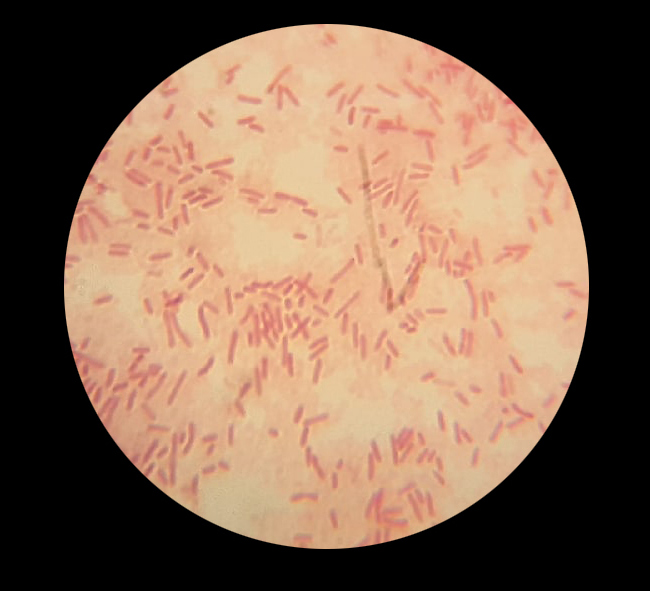
Image source: Wikipedia/Wikimedia
| Ecology, Host, and Life Cycle | |
|---|---|
| Oxygen requirements | Microaerophilic |
| Optimal temperature | 37 |
| Temperature range | Mesophilic |
| Habitat | HostAssociated |
| Biotic relationship | Free living |
| Host(s) | Not Available |
| Cell arrangement | Chains - Singles |
| Sporulation | Not Available |
| Energy source | Chemoorganotroph |
| Pathogenicity | Not Available |
Gene Summary
Adenine Count
1180452 bp
Thymine Count
1177655 bp
Guanine Count
1268707 bp
Cytosine Count
1268362 bp
Genome Length
4895176 bp
Protein-coding Genes
4608 genes
Non-Coding Genes
302 genes
# of Chromosomes/Plasmids
1
Genes
| Name | Locus Tag | UniProt ID | Strand Orientation | Gene Start/End | Protein Molecular Weight |
|---|---|---|---|---|---|
| fimbrial biogenesis outer membrane usher protein | FGD25_05160 | Not Available | Negative | 993801 - 996500 | 98656.6 |
| fimbrial protein stea | FGD25_05165 | Not Available | Negative | 996580 - 997167 | 19859.2 |
| hypothetical protein | FGD25_05170 | Not Available | Positive | 997349 - 997554 | 7598.9 |
| hypothetical protein | FGD25_05175 | Not Available | Negative | 997783 - 998262 | 16403.6 |
| protein mgtr | FGD25_05180 | Not Available | Negative | 998463 - 998555 | 3457.58 |
| magnesium-translocating p-type atpase | FGD25_05185 | Not Available | Negative | 998577 - 1001303 | 100373.0 |
| mgtc family protein | FGD25_05190 | Not Available | Negative | 1001523 - 1002218 | 25066.8 |
| type ii toxin-antitoxin system rele/pare family toxin | FGD25_05195 | Not Available | Negative | 1002937 - 1003233 | 11513.8 |
| type ii toxin-antitoxin system pard family antitoxin | FGD25_05200 | Not Available | Negative | 1003199 - 1003555 | 13576.4 |
| gtp diphosphokinase | FGD25_05205 | Not Available | Negative | 1003639 - 1005873 | 84103.8 |
Pathways
0 pathways
No pathways found
No metabolic pathways have been associated with this bacterium yet.
Health Effects
No health effects information available for this bacterium.