Kingdom
Pseudomonadati
Phylum
Pseudomonadota
Class
Gammaproteobacteria
Order
Enterobacterales
Family
Enterobacteriaceae
Genus
Salmonella
Description
Taxonomy
| Kingdom | Pseudomonadati |
|---|---|
| Phylum | Pseudomonadota |
| Class | Gammaproteobacteria |
| Order | Enterobacterales |
| Family | Enterobacteriaceae |
| Genus | Salmonella |
| Species | Salmonella enterica |
| Strain | subsp. enterica serovar Infantis |
Profile
| Physiology | |
|---|---|
| Gram staining properties | Negative |
| Shape | Spirilla |
| Mobility | No |
| Flagellar presence | Yes |
| Number of membranes | 2 |

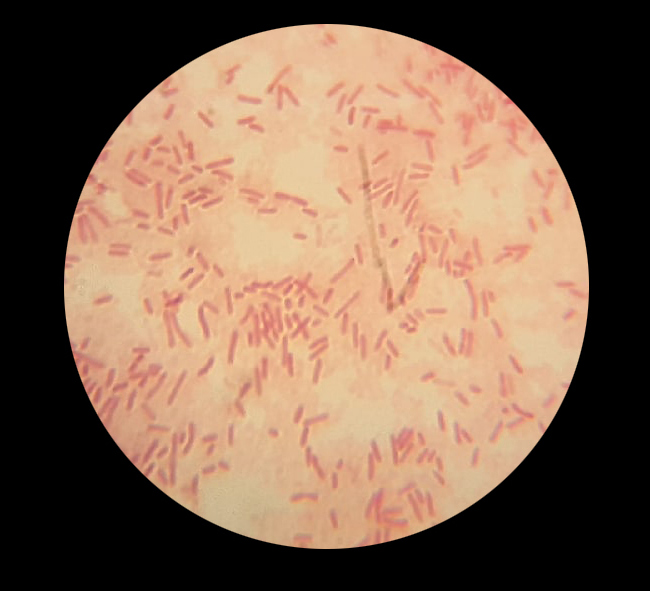
Image source: Wikipedia/Wikimedia
| Ecology, Host, and Life Cycle | |
|---|---|
| Oxygen requirements | Microaerophilic |
| Optimal temperature | 37 |
| Temperature range | Mesophilic |
| Habitat | HostAssociated |
| Biotic relationship | Free living |
| Host(s) | Homo sapiens, Gallus gallus, Aves |
| Cell arrangement | Chains - Singles |
| Sporulation | Not Available |
| Energy source | Chemoorganotroph |
| Pathogenicity | Not Available |
Gene Summary
Adenine Count
Not Available
Thymine Count
Not Available
Guanine Count
Not Available
Cytosine Count
Not Available
Genome Length
Not Available
Protein-coding Genes
4698 genes
Non-Coding Genes
244 genes
# of Chromosomes/Plasmids
1
Genes
| Name | Locus Tag | UniProt ID | Strand Orientation | Gene Start/End | Protein Molecular Weight |
|---|---|---|---|---|---|
| Hypothetical protein | CEU21_20060 | Not Available | Negative | 3942513 - 3942737 | 8308.9 |
| Replication gene b protein | CEU21_20065 | Not Available | Negative | 3942801 - 3943301 | 19941.1 |
| Cox | CEU21_20070 | Not Available | Negative | 3943471 - 3943743 | 10459.7 |
| C protein | CEU21_20075 | Not Available | Positive | 3943880 - 3944173 | 10583.8 |
| Phage integrase | CEU21_20080 | Not Available | Positive | 3944243 - 3945223 | 36987.0 |
| cell-envelope stress modulator cpxp | CEU21_20085 | Not Available | Negative | 3945409 - 3945909 | 19047.6 |
| Putative dna-binding response regulator | CEU21_20090 | Not Available | Positive | 3946060 - 3946758 | 26275.7 |
| Attr | Not Available | Not Available | Positive | 3949167 - 3949179 | Not Available |
| Gp01 | CEU21_21915 | Not Available | Negative | 4293984 - 4294331 | 13382.1 |
| Gp51 | CEU21_21920 | Not Available | Positive | 4294908 - 4295195 | 10420.2 |
Pathways
0 pathways
No pathways found
No metabolic pathways have been associated with this bacterium yet.