Kingdom
Pseudomonadati
Phylum
Pseudomonadota
Class
Gammaproteobacteria
Order
Enterobacterales
Family
Enterobacteriaceae
Genus
Salmonella
Description
Taxonomy
| Kingdom | Pseudomonadati |
|---|---|
| Phylum | Pseudomonadota |
| Class | Gammaproteobacteria |
| Order | Enterobacterales |
| Family | Enterobacteriaceae |
| Genus | Salmonella |
| Species | Salmonella enterica |
| Strain | subsp. enterica serovar Infantis |
Profile
| Physiology | |
|---|---|
| Gram staining properties | Negative |
| Shape | Spirilla |
| Mobility | No |
| Flagellar presence | Yes |
| Number of membranes | 2 |

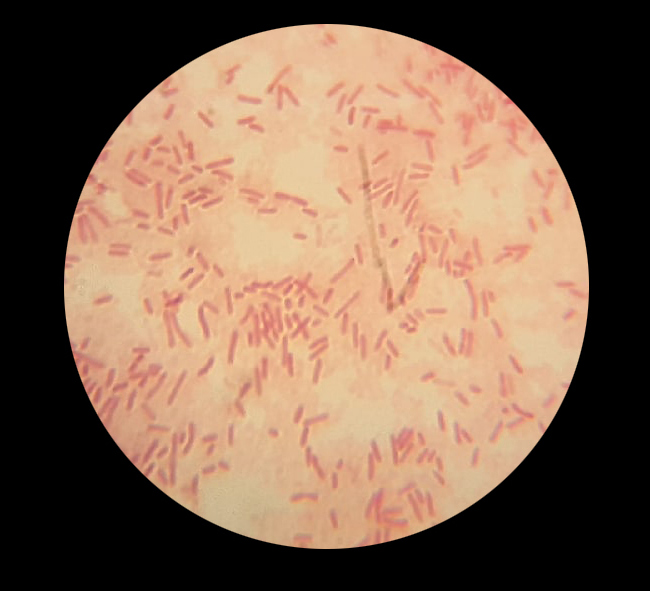
Image source: Wikipedia/Wikimedia
| Ecology, Host, and Life Cycle | |
|---|---|
| Oxygen requirements | Microaerophilic |
| Optimal temperature | 37 |
| Temperature range | Mesophilic |
| Habitat | HostAssociated |
| Biotic relationship | Free living |
| Host(s) | Homo sapiens, Gallus gallus, Aves |
| Cell arrangement | Chains - Singles |
| Sporulation | Not Available |
| Energy source | Chemoorganotroph |
| Pathogenicity | Not Available |
Gene Summary
Adenine Count
Not Available
Thymine Count
Not Available
Guanine Count
Not Available
Cytosine Count
Not Available
Genome Length
Not Available
Protein-coding Genes
4698 genes
Non-Coding Genes
244 genes
# of Chromosomes/Plasmids
1
Genes
| Name | Locus Tag | UniProt ID | Strand Orientation | Gene Start/End | Protein Molecular Weight |
|---|---|---|---|---|---|
| udp-n-acetylmuramate dehydrogenase | CEU21_25190 | Not Available | Positive | 4911126 - 4912154 | 37702.2 |
| bifunctional biotin--[acetyl-coa-carboxylase] ligase/biotin operon repressor bira | CEU21_25195 | Not Available | Positive | 4912151 - 4913113 | 35398.1 |
| type i pantothenate kinase | CEU21_25200 | Not Available | Negative | 4913148 - 4914098 | 36237.5 |
| hypothetical protein | CEU21_25210 | Not Available | Negative | 4914307 - 4914480 | 6943.7 |
| Trna-thr | Not Available | Not Available | Positive | 4914500 - 4914575 | Not Available |
| Trna-tyr | Not Available | Not Available | Positive | 4914584 - 4914668 | Not Available |
| Trna-gly | Not Available | Not Available | Positive | 4914785 - 4914859 | Not Available |
| Trna-thr | Not Available | Not Available | Positive | 4914866 - 4914941 | Not Available |
| gtp-binding protein | CEU21_25235 | Not Available | Positive | 4915057 - 4915559 | 18494.9 |
| cytochrome c biogenesis protein ccmh | CEU21_25240 | Not Available | Negative | 4915560 - 4916582 | 37680.7 |
Pathways
0 pathways
No pathways found
No metabolic pathways have been associated with this bacterium yet.