Kingdom
Pseudomonadati
Phylum
Pseudomonadota
Class
Gammaproteobacteria
Order
Enterobacterales
Family
Enterobacteriaceae
Genus
Escherichia
Description
Taxonomy
| Kingdom | Pseudomonadati |
|---|---|
| Phylum | Pseudomonadota |
| Class | Gammaproteobacteria |
| Order | Enterobacterales |
| Family | Enterobacteriaceae |
| Genus | Escherichia |
| Species | Escherichia coli |
| Strain | JPH493 |
Profile
| Physiology | |
|---|---|
| Gram staining properties | Negative |
| Shape | Rod |
| Mobility | Yes |
| Flagellar presence | Yes |
| Number of membranes | 2 |

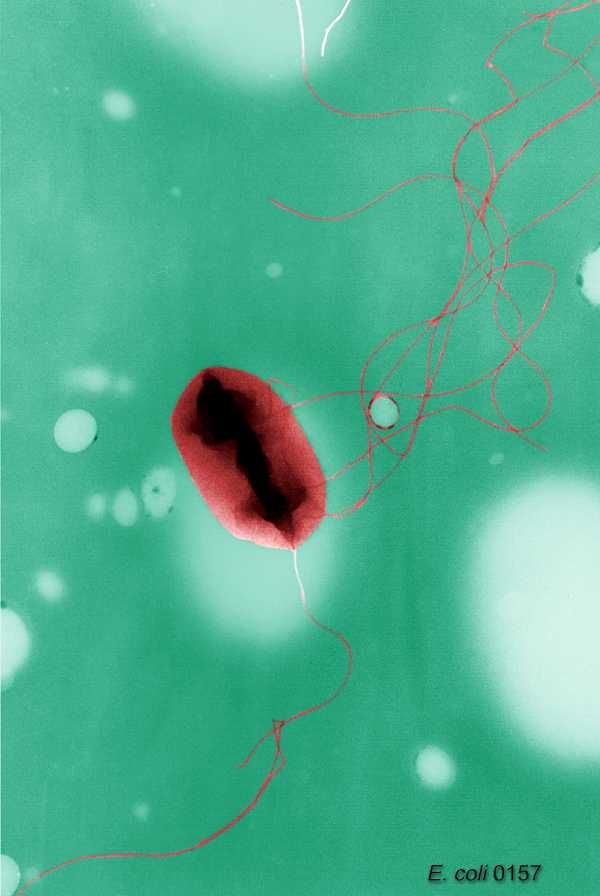
Image source: Wikipedia/Wikimedia
| Ecology, Host, and Life Cycle | |
|---|---|
| Oxygen requirements | Facultative anaerobe |
| Optimal temperature | 37 |
| Temperature range | Mesophilic |
| Habitat | HostAssociated |
| Biotic relationship | Free living |
| Host(s) | Homo sapiens, Gallus gallus, Bos taurus |
| Cell arrangement | Pairs - Singles |
| Sporulation | Not Available |
| Energy source | Not Available |
| Pathogenicity | Human |
Gene Summary
Adenine Count
1295780 bp
Thymine Count
1293439 bp
Guanine Count
1334851 bp
Cytosine Count
1317027 bp
Genome Length
5241097 bp
Protein-coding Genes
5329 genes
Non-Coding Genes
292 genes
# of Chromosomes/Plasmids
1
Genes
| Name | Locus Tag | UniProt ID | Strand Orientation | Gene Start/End | Protein Molecular Weight |
|---|---|---|---|---|---|
| 4-hydroxythreonine-4-phosphate dehydrogenase | HMPREF3040_02483 | Not Available | Negative | 2391216 - 2392205 | 35164.9 |
| ppic-type ppiase domain protein | HMPREF3040_02484 | Not Available | Negative | 2392205 - 2393491 | 47286.5 |
| organic solvent tolerance protein | HMPREF3040_02485 | Not Available | Negative | 2393544 - 2395898 | 89675.8 |
| dnaj-like protein djla | HMPREF3040_02486 | Not Available | Positive | 2396153 - 2396968 | 30567.2 |
| hypothetical protein | HMPREF3040_02487 | Not Available | Positive | 2397284 - 2397994 | 26645.1 |
| hypothetical protein | HMPREF3040_02488 | Not Available | Negative | 2398223 - 2398360 | 5243.5 |
| pseudouridine synthase a | HMPREF3040_02489 | Not Available | Negative | 2398402 - 2399061 | 24862.1 |
| atp-dependent helicase hepa | HMPREF3040_02490 | Not Available | Negative | 2399073 - 2401979 | 109775.0 |
| dna polymerase ii | HMPREF3040_02491 | Not Available | Negative | 2402143 - 2404494 | 89935.6 |
| l-ribulose-5-phosphate 4-epimerase | HMPREF3040_02492 | Not Available | Negative | 2404569 - 2405264 | 25547.4 |
Pathways
12799 pathways
Health Effects
| Health Condition | Relation | Reference |
|---|---|---|
| Gi disease | Causes | PMC11149725 |
| Utis | Causes | PMC11434687 |
| Colorectal cancer | Causes | PMC12198655 |
| Pyogenic liver abscesses | Causes | PMC12392612 |
| Uti | Causes | PMC13014981 |
| Colibacillosis | Causes | PMC13255289 |
| Enteric infections | Causes | PMC13255289 |
| Foodborne infections | Causes | PMC13255289 |
| Clinical mastitis | Causes | PMC13293316 |
| Diarrhea | Causes | PMC3035056 |