Kingdom
Pseudomonadati
Phylum
Pseudomonadota
Class
Gammaproteobacteria
Order
Enterobacterales
Family
Enterobacteriaceae
Genus
Escherichia
Description
Taxonomy
| Kingdom | Pseudomonadati |
|---|---|
| Phylum | Pseudomonadota |
| Class | Gammaproteobacteria |
| Order | Enterobacterales |
| Family | Enterobacteriaceae |
| Genus | Escherichia |
| Species | Escherichia coli |
| Strain | BE104 |
Profile
| Physiology | |
|---|---|
| Gram staining properties | Negative |
| Shape | Rod |
| Mobility | Yes |
| Flagellar presence | Yes |
| Number of membranes | 2 |

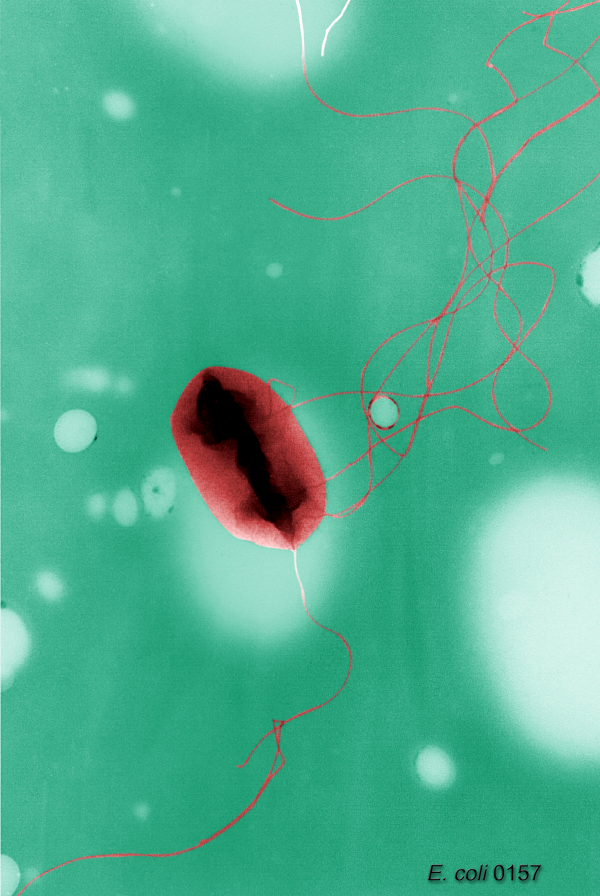
Image source: Wikipedia/Wikimedia
| Ecology, Host, and Life Cycle | |
|---|---|
| Oxygen requirements | Facultative anaerobe |
| Optimal temperature | 37 |
| Temperature range | Mesophilic |
| Habitat | HostAssociated |
| Biotic relationship | Free living |
| Host(s) | Homo sapiens, Gallus gallus, Bos taurus |
| Cell arrangement | Pairs - Singles |
| Sporulation | Not Available |
| Energy source | Not Available |
| Pathogenicity | Human |
Gene Summary
Adenine Count
1176476 bp
Thymine Count
1174817 bp
Guanine Count
1212144 bp
Cytosine Count
1211685 bp
Genome Length
4775122 bp
Protein-coding Genes
4377 genes
Non-Coding Genes
324 genes
# of Chromosomes/Plasmids
1
Genes
| Name | Locus Tag | UniProt ID | Strand Orientation | Gene Start/End | Protein Molecular Weight |
|---|---|---|---|---|---|
| proline-specific permease proy | FGC38_RS02520 | Not Available | Positive | 507649 - 509022 | 50218.8 |
| maltodextrin glucosidase | FGC38_RS02525 | Not Available | Positive | 509178 - 510995 | 69175.9 |
| acp phosphodiesterase | FGC38_RS02530 | Not Available | Negative | 511000 - 511581 | 22962.3 |
| trna preq1(34) s-adenosylmethionine ribosyltransferase-isomerase quea | FGC38_RS02535 | Not Available | Positive | 511674 - 512744 | 39433.0 |
| trna guanosine(34) transglycosylase tgt | FGC38_RS02540 | Not Available | Positive | 512800 - 513927 | 42596.1 |
| preprotein translocase subunit yajc | FGC38_RS02545 | Not Available | Positive | 513950 - 514282 | 11887.9 |
| protein translocase subunit secd | FGC38_RS02550 | Not Available | Positive | 514310 - 516157 | 66636.3 |
| protein translocase subunit secf | FGC38_RS02555 | Not Available | Positive | 516168 - 517139 | 35384.6 |
| hnh nuclease yajd | FGC38_RS02560 | Not Available | Positive | 517268 - 517615 | 13364.7 |
| nucleoside-specific channel-forming protein tsx | FGC38_RS02565 | Not Available | Negative | 517792 - 518676 | 33590.6 |
Pathways
12367 pathways
Health Effects
| Health Condition | Relation | Reference |
|---|---|---|
| Gi disease | Causes | PMC11149725 |
| Utis | Causes | PMC11434687 |
| Colorectal cancer | Causes | PMC12198655 |
| Pyogenic liver abscesses | Causes | PMC12392612 |
| Uti | Causes | PMC13014981 |
| Colibacillosis | Causes | PMC13255289 |
| Enteric infections | Causes | PMC13255289 |
| Foodborne infections | Causes | PMC13255289 |
| Clinical mastitis | Causes | PMC13293316 |
| Diarrhea | Causes | PMC3035056 |