Kingdom
Pseudomonadati
Phylum
Pseudomonadota
Class
Gammaproteobacteria
Order
Enterobacterales
Family
Enterobacteriaceae
Genus
Escherichia
Description
Taxonomy
| Kingdom | Pseudomonadati |
|---|---|
| Phylum | Pseudomonadota |
| Class | Gammaproteobacteria |
| Order | Enterobacterales |
| Family | Enterobacteriaceae |
| Genus | Escherichia |
| Species | Escherichia coli |
| Strain | BE104 |
Profile
| Physiology | |
|---|---|
| Gram staining properties | Negative |
| Shape | Rod |
| Mobility | Yes |
| Flagellar presence | Yes |
| Number of membranes | 2 |

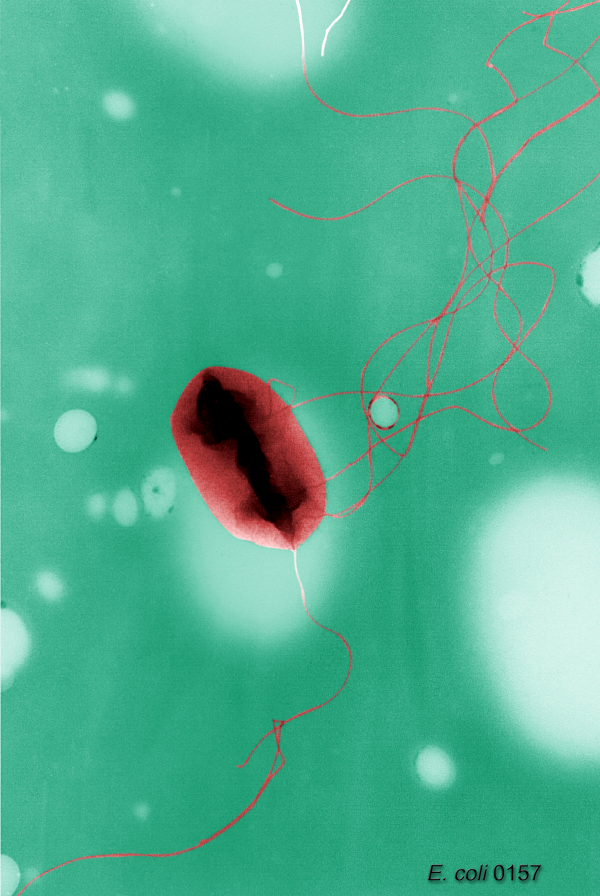
Image source: Wikipedia/Wikimedia
| Ecology, Host, and Life Cycle | |
|---|---|
| Oxygen requirements | Facultative anaerobe |
| Optimal temperature | 37 |
| Temperature range | Mesophilic |
| Habitat | HostAssociated |
| Biotic relationship | Free living |
| Host(s) | Homo sapiens, Gallus gallus, Bos taurus |
| Cell arrangement | Pairs - Singles |
| Sporulation | Not Available |
| Energy source | Not Available |
| Pathogenicity | Human |
Gene Summary
Adenine Count
1176476 bp
Thymine Count
1174817 bp
Guanine Count
1212144 bp
Cytosine Count
1211685 bp
Genome Length
4775122 bp
Protein-coding Genes
4377 genes
Non-Coding Genes
324 genes
# of Chromosomes/Plasmids
1
Genes
| Name | Locus Tag | UniProt ID | Strand Orientation | Gene Start/End | Protein Molecular Weight |
|---|---|---|---|---|---|
| no-inducible flavohemoprotein | FGC38_RS13955 | Not Available | Positive | 2817389 - 2818579 | 43870.1 |
| nitrogen regulatory protein p-ii | FGC38_RS13960 | Not Available | Negative | 2818624 - 2818962 | 12426.2 |
| two-component system response regulator glrr | FGC38_RS13965 | Not Available | Negative | 2819023 - 2820357 | 49151.3 |
| two-component system qseef-associated lipoprotein qseg | FGC38_RS13970 | Not Available | Negative | 2820347 - 2821060 | 27349.4 |
| two component system sensor histidine kinase qsee/glrk | FGC38_RS13975 | Not Available | Negative | 2821225 - 2822652 | 53333.6 |
| phosphoribosylformylglycinamidine synthase | FGC38_RS13980 | Not Available | Negative | 2823210 - 2827097 | 141411.0 |
| membrane-bound lytic murein transglycosylase mltf | FGC38_RS13985 | Not Available | Positive | 2827355 - 2828911 | 58305.3 |
| trna adenosine(34) deaminase tada | FGC38_RS13990 | Not Available | Negative | 2828908 - 2829411 | 18718.7 |
| phosphatidylglycerophosphatase c | FGC38_RS13995 | Not Available | Negative | 2829469 - 2830104 | 24440.8 |
| murr/rpir family transcriptional regulator | FGC38_RS14000 | Not Available | Positive | 2830313 - 2831161 | 30709.3 |
Pathways
12367 pathways
Health Effects
| Health Condition | Relation | Reference |
|---|---|---|
| Gi disease | Causes | PMC11149725 |
| Utis | Causes | PMC11434687 |
| Colorectal cancer | Causes | PMC12198655 |
| Pyogenic liver abscesses | Causes | PMC12392612 |
| Uti | Causes | PMC13014981 |
| Colibacillosis | Causes | PMC13255289 |
| Enteric infections | Causes | PMC13255289 |
| Foodborne infections | Causes | PMC13255289 |
| Clinical mastitis | Causes | PMC13293316 |
| Diarrhea | Causes | PMC3035056 |