Kingdom
Pseudomonadati
Phylum
Pseudomonadota
Class
Gammaproteobacteria
Order
Legionellales
Family
Legionellaceae
Genus
Legionella
Description
Taxonomy
| Kingdom | Pseudomonadati |
|---|---|
| Phylum | Pseudomonadota |
| Class | Gammaproteobacteria |
| Order | Legionellales |
| Family | Legionellaceae |
| Genus | Legionella |
| Species | Legionella steigerwaltii |
| Strain | No strain |
Profile
| Physiology | |
|---|---|
| Gram staining properties | Not Available |
| Shape | Rod |
| Mobility | Not Available |
| Flagellar presence | Yes |
| Number of membranes | Not Available |

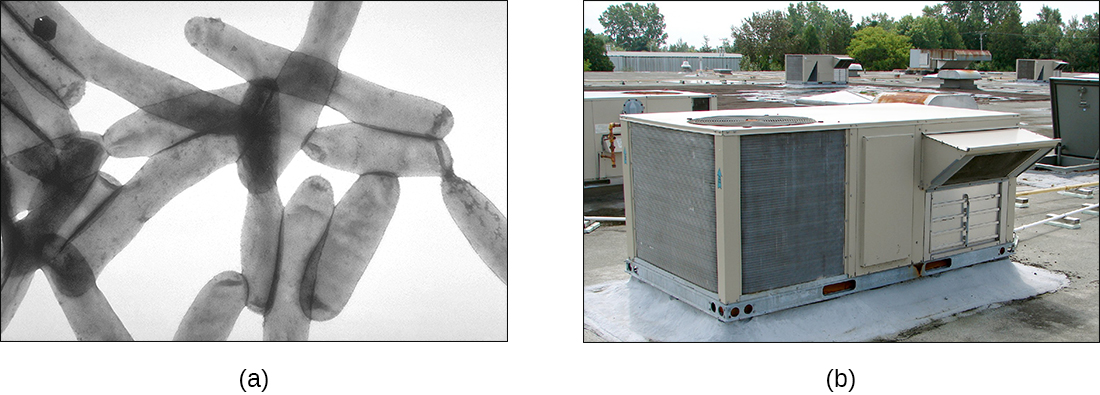
Image source: Wikipedia/Wikimedia
| Ecology, Host, and Life Cycle | |
|---|---|
| Oxygen requirements | microaerophile |
| Optimal temperature | Not Available |
| Temperature range | Not Available |
| Habitat | Not Available |
| Biotic relationship | Not Available |
| Host(s) | Not Available |
| Cell arrangement | Not Available |
| Sporulation | Not Available |
| Energy source | Not Available |
| Pathogenicity | Not Available |
Gene Summary
Adenine Count
Not Available
Thymine Count
Not Available
Guanine Count
Not Available
Cytosine Count
Not Available
Genome Length
Not Available
Protein-coding Genes
3503 genes
Non-Coding Genes
52 genes
# of Chromosomes/Plasmids
1
Genes
| Name | Locus Tag | UniProt ID | Strand Orientation | Gene Start/End | Protein Molecular Weight |
|---|---|---|---|---|---|
| aspartyl-trna synthetase | NCTC11991_01614 | Not Available | Positive | 1802453 - 1804234 | 66851.6 |
| mechanosensitive ion channel mscs | NCTC11991_01615 | Not Available | Positive | 1804209 - 1807289 | 117667.0 |
| dna mismatch repair protein muth | NCTC11991_01616 | Not Available | Positive | 1807261 - 1807932 | 25083.2 |
| phosphatase | NCTC11991_01617 | Not Available | Negative | 1807999 - 1808799 | 30098.1 |
| ribulose-5-phosphate 4-epimerase and related epimerases and aldolases | NCTC11991_01618 | Not Available | Positive | 1809107 - 1811518 | 91459.0 |
| uncharacterised protein | NCTC11991_01619 | Not Available | Positive | 1811594 - 1812556 | 34642.4 |
| gnat family acetyltransferase | NCTC11991_01620 | Not Available | Negative | 1812768 - 1813241 | 18349.0 |
| amidase | NCTC11991_01621 | Not Available | Negative | 1813257 - 1814636 | 50047.6 |
| envelope stress induced periplasmic protein | NCTC11991_01622 | Not Available | Negative | 1814707 - 1815147 | 16416.0 |
| inner membrane protein plus sensory box protein lsse | NCTC11991_01623 | Not Available | Negative | 1815290 - 1821007 | 218737.0 |
Pathways
0 pathways
No pathways found
No metabolic pathways have been associated with this bacterium yet.
Health Effects
No health effects information available for this bacterium.