Kingdom
Pseudomonadati
Phylum
Pseudomonadota
Class
Gammaproteobacteria
Order
Legionellales
Family
Legionellaceae
Genus
Legionella
Description
Taxonomy
| Kingdom | Pseudomonadati |
|---|---|
| Phylum | Pseudomonadota |
| Class | Gammaproteobacteria |
| Order | Legionellales |
| Family | Legionellaceae |
| Genus | Legionella |
| Species | Legionella steigerwaltii |
| Strain | No strain |
Profile
| Physiology | |
|---|---|
| Gram staining properties | Not Available |
| Shape | Rod |
| Mobility | Not Available |
| Flagellar presence | Yes |
| Number of membranes | Not Available |

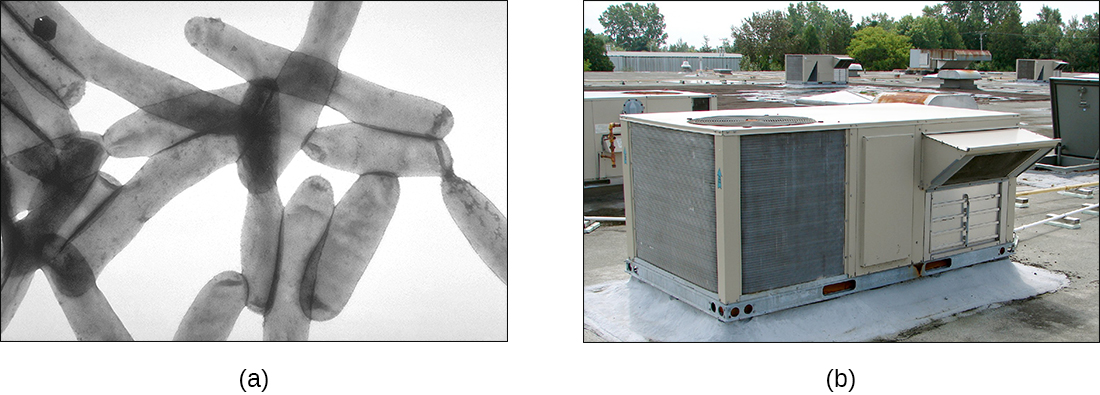
Image source: Wikipedia/Wikimedia
| Ecology, Host, and Life Cycle | |
|---|---|
| Oxygen requirements | microaerophile |
| Optimal temperature | Not Available |
| Temperature range | Not Available |
| Habitat | Not Available |
| Biotic relationship | Not Available |
| Host(s) | Not Available |
| Cell arrangement | Not Available |
| Sporulation | Not Available |
| Energy source | Not Available |
| Pathogenicity | Not Available |
Gene Summary
Adenine Count
Not Available
Thymine Count
Not Available
Guanine Count
Not Available
Cytosine Count
Not Available
Genome Length
Not Available
Protein-coding Genes
3503 genes
Non-Coding Genes
52 genes
# of Chromosomes/Plasmids
1
Genes
| Name | Locus Tag | UniProt ID | Strand Orientation | Gene Start/End | Protein Molecular Weight |
|---|---|---|---|---|---|
| carboxylate-amine ligase | NCTC11991_01063 | Not Available | Positive | 1177618 - 1178805 | 44607.4 |
| luxr family transcriptional regulator | NCTC11991_01064 | Not Available | Positive | 1179093 - 1179818 | 28112.6 |
| leucine-rich repeat-containing protein (substrate of the dot/icm secretion system) | NCTC11991_01065 | Not Available | Positive | 1180157 - 1181338 | 40762.9 |
| leucine-rich repeat-containing protein | NCTC11991_01066 | Not Available | Positive | 1181828 - 1182907 | 39005.5 |
| leucine-rich repeat-containing protein (substrate of the dot/icm secretion system) | NCTC11991_01067 | Not Available | Positive | 1182967 - 1184160 | 41862.0 |
| leucine-rich repeat-containing protein | NCTC11991_01068 | Not Available | Positive | 1184316 - 1185398 | 37915.6 |
| transposase and inactivated derivatives | NCTC11991_01069 | Not Available | Positive | 1185558 - 1186163 | 23343.0 |
| uncharacterized protein conserved in bacteria | NCTC11991_01070 | Not Available | Negative | 1186220 - 1186708 | 17686.9 |
| geranylgeranyl reductase family | NCTC11991_01071 | Not Available | Positive | 1187241 - 1189055 | 68110.8 |
| transposase and inactivated derivatives | NCTC11991_01072 | Not Available | Negative | 1189131 - 1190003 | 33597.1 |
Pathways
0 pathways
No pathways found
No metabolic pathways have been associated with this bacterium yet.
Health Effects
No health effects information available for this bacterium.