Kingdom
Pseudomonadati
Phylum
Pseudomonadota
Class
Gammaproteobacteria
Order
Legionellales
Family
Legionellaceae
Genus
Legionella
Description
Taxonomy
| Kingdom | Pseudomonadati |
|---|---|
| Phylum | Pseudomonadota |
| Class | Gammaproteobacteria |
| Order | Legionellales |
| Family | Legionellaceae |
| Genus | Legionella |
| Species | Legionella feeleii |
| Strain | No strain |
Profile
| Physiology | |
|---|---|
| Gram staining properties | Not Available |
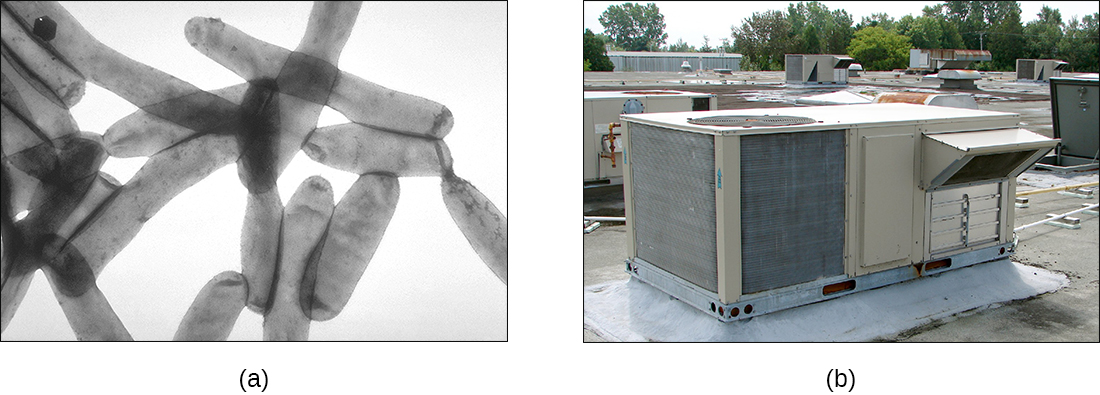
| Shape | Rod |
| Mobility | Not Available |
| Flagellar presence | Yes |
| Number of membranes | Not Available |

Image source: Wikipedia/Wikimedia
| Ecology, Host, and Life Cycle | |
|---|---|
| Oxygen requirements | Not Available |
| Optimal temperature | Not Available |
| Temperature range | Not Available |
| Habitat | cooling towers; water distribution systems; water networks |
| Biotic relationship | Not Available |
| Host(s) | Homo sapiens |
| Cell arrangement | Not Available |
| Sporulation | Not Available |
| Energy source | Not Available |
| Pathogenicity | Not Available |
Gene Summary
Adenine Count
1090767 bp
Thymine Count
1115367 bp
Guanine Count
795873 bp
Cytosine Count
743482 bp
Genome Length
3745489 bp
Protein-coding Genes
3589 genes
Non-Coding Genes
63 genes
# of Chromosomes/Plasmids
1
Genes
| Name | Locus Tag | UniProt ID | Strand Orientation | Gene Start/End | Protein Molecular Weight |
|---|---|---|---|---|---|
| (serine-type) d-alanyl-d-alanine carboxypeptidase | NCTC12022_00106 | Not Available | Negative | 110930 - 112108 | 43832.9 |
| uncharacterised protein family (upf0270) | NCTC12022_00107 | Not Available | Positive | 112211 - 112468 | 9782.81 |
| uncharacterised protein | NCTC12022_00108 | Not Available | Positive | 112934 - 114349 | 52450.8 |
| 23s ribosomal rna | Not Available | Not Available | Positive | 113979 - 116864 | Not Available |
| uncharacterised protein | NCTC12022_00109 | Not Available | Positive | 114374 - 114772 | 14974.1 |
| uncharacterised protein | NCTC12022_00110 | Not Available | Positive | 115180 - 115515 | 12889.5 |
| uncharacterised protein | NCTC12022_00111 | Not Available | Positive | 116038 - 116397 | 13584.2 |
| uncharacterised protein | NCTC12022_00112 | Not Available | Positive | 116549 - 116920 | 13638.5 |
| uncharacterised protein | NCTC12022_00113 | Not Available | Positive | 117603 - 118139 | 20166.5 |
| serine/threonine-protein kinase | NCTC12022_00114 | Not Available | Positive | 119026 - 122490 | 130586.0 |
Pathways
0 pathways
No pathways found
No metabolic pathways have been associated with this bacterium yet.
Health Effects
| Health Condition | Relation | Reference |
|---|---|---|
| Legionnaire's disease | Causes | PMC8023197 |
| Legionnaires' disease | Causes | PMC8972187 |
| Pontiac fever | Causes | PMC9867486 |
| Legionnaires disease | Causes | PMC9867486 |