Kingdom
Pseudomonadati
Phylum
Campylobacterota
Class
Epsilonproteobacteria
Order
Campylobacterales
Family
Helicobacteraceae
Genus
Helicobacter
Description
Taxonomy
| Kingdom | Pseudomonadati |
|---|---|
| Phylum | Campylobacterota |
| Class | Epsilonproteobacteria |
| Order | Campylobacterales |
| Family | Helicobacteraceae |
| Genus | Helicobacter |
| Species | Helicobacter muridarum |
| Strain | No strain |
Profile
| Physiology | |
|---|---|
| Gram staining properties | Not Available |
| Shape | Not Available |
| Mobility | Yes |
| Flagellar presence | Not Available |
| Number of membranes | Not Available |

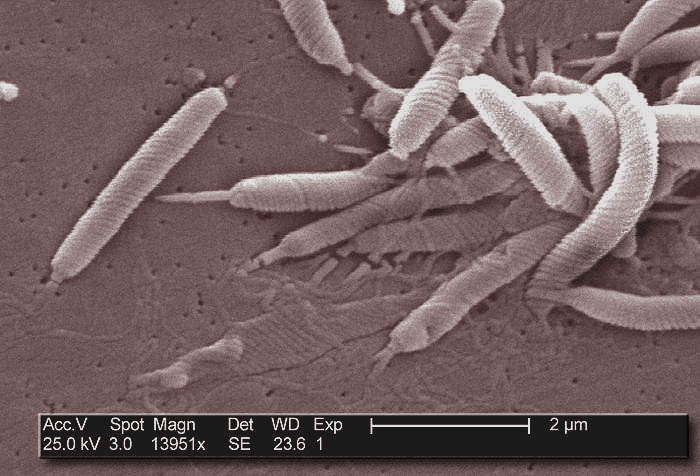
Image source: Wikipedia/Wikimedia
| Ecology, Host, and Life Cycle | |
|---|---|
| Oxygen requirements | microaerophile |
| Optimal temperature | Not Available |
| Temperature range | Not Available |
| Habitat | Not Available |
| Biotic relationship | Not Available |
| Host(s) | Metazoa, Rodentia |
| Cell arrangement | Not Available |
| Sporulation | Not Available |
| Energy source | Not Available |
| Pathogenicity | Not Available |
Gene Summary
Adenine Count
753352 bp
Thymine Count
771514 bp
Guanine Count
376893 bp
Cytosine Count
361577 bp
Genome Length
2263336 bp
Protein-coding Genes
1964 genes
Non-Coding Genes
52 genes
# of Chromosomes/Plasmids
1
Genes
| Name | Locus Tag | UniProt ID | Strand Orientation | Gene Start/End | Protein Molecular Weight |
|---|---|---|---|---|---|
| hydrogenase large chain | NCTC12714_00038 | Not Available | Positive | 32144 - 33904 | 65173.1 |
| ni/fe-hydrogenase b-type cytochrome subunit | NCTC12714_00039 | Not Available | Positive | 33998 - 34702 | 26502.7 |
| hydrogenase formation/expression protease hyad/hupd | NCTC12714_00040 | Not Available | Positive | 34723 - 35271 | 20004.2 |
| protein hyde | NCTC12714_00041 | Not Available | Positive | 35325 - 37367 | 77424.9 |
| holliday junction resolvase | NCTC12714_00042 | Not Available | Positive | 37441 - 37929 | 17907.0 |
| uncharacterised protein | NCTC12714_00043 | Not Available | Negative | 38264 - 38971 | 26655.1 |
| uncharacterised protein | NCTC12714_00044 | Not Available | Negative | 38981 - 39271 | 11184.8 |
| uncharacterised protein | NCTC12714_00045 | Not Available | Negative | 39359 - 40267 | 33755.3 |
| uncharacterised protein | NCTC12714_00046 | Not Available | Negative | 40410 - 40574 | 6220.75 |
| dna recombination protein | NCTC12714_00047 | Not Available | Negative | 40696 - 42297 | 62171.0 |
Pathways
0 pathways
No pathways found
No metabolic pathways have been associated with this bacterium yet.
Health Effects
| Health Condition | Relation | Reference |
|---|---|---|
| Colonic inflammation | Causes | PMC7459201 |
| Colitis | Causes | PMC7459201 |
| Gastritis | Causes | PMC7459201 |
| Dilatation of glandular crypts, edema, and destruction of epithelium and glands | Causes | PMC7459201 |
| Subclinical colitis | Causes | PMC7459201 |