Kingdom
Pseudomonadati
Phylum
Campylobacterota
Class
Epsilonproteobacteria
Order
Campylobacterales
Family
Helicobacteraceae
Genus
Helicobacter
Description
Taxonomy
| Kingdom | Pseudomonadati |
|---|---|
| Phylum | Campylobacterota |
| Class | Epsilonproteobacteria |
| Order | Campylobacterales |
| Family | Helicobacteraceae |
| Genus | Helicobacter |
| Species | Helicobacter pylori |
| Strain | ZH39 |
Profile
| Physiology | |
|---|---|
| Gram staining properties | Negative |
| Shape | Spirilla |
| Mobility | No |
| Flagellar presence | Yes |
| Number of membranes | 2 |

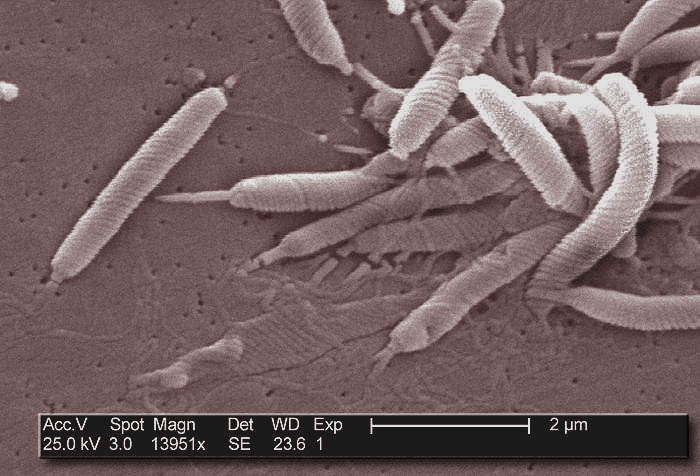
Image source: Wikipedia/Wikimedia
| Ecology, Host, and Life Cycle | |
|---|---|
| Oxygen requirements | Microaerophilic |
| Optimal temperature | 37 |
| Temperature range | Mesophilic |
| Habitat | HostAssociated |
| Biotic relationship | Free living |
| Host(s) | Homo sapiens, Gallus gallus, Aves |
| Cell arrangement | Singles |
| Sporulation | Not Available |
| Energy source | Not Available |
| Pathogenicity | Human |
Gene Summary
Adenine Count
496405 bp
Thymine Count
501991 bp
Guanine Count
315821 bp
Cytosine Count
318927 bp
Genome Length
1635446 bp
Protein-coding Genes
1452 genes
Non-Coding Genes
64 genes
# of Chromosomes/Plasmids
1
Genes
| Name | Locus Tag | UniProt ID | Strand Orientation | Gene Start/End | Protein Molecular Weight |
|---|---|---|---|---|---|
| 50s ribosomal protein l1 | ECC37_05120 | Not Available | Positive | 1052190 - 1052894 | 25282.0 |
| 50s ribosomal protein l10 | ECC37_05125 | Not Available | Positive | 1053003 - 1053497 | 18606.7 |
| 50s ribosomal protein l7/l12 | ECC37_05130 | Not Available | Positive | 1053542 - 1053919 | 13299.1 |
| dna-directed rna polymerase subunit beta/beta' | ECC37_05140 | Not Available | Positive | 1054142 - 1062814 | 323746.0 |
| 30s ribosomal protein s12 | ECC37_05145 | Not Available | Positive | 1062903 - 1063310 | 15106.7 |
| 30s ribosomal protein s7 | ECC37_05150 | Not Available | Positive | 1063326 - 1063793 | 17972.0 |
| elongation factor g | ECC37_05155 | Not Available | Positive | 1063805 - 1065883 | 77054.6 |
| aldo/keto reductase | ECC37_05160 | Not Available | Negative | 1066440 - 1067429 | 37176.0 |
| hypothetical protein | ECC37_05170 | Not Available | Positive | 1067649 - 1067870 | 8001.8 |
| lipopolysaccharide heptosyltransferase ii | ECC37_05175 | Not Available | Negative | 1068063 - 1069112 | 39572.5 |
Pathways
1109 pathways
Health Effects
| Health Condition | Relation | Reference |
|---|---|---|
| Chronic gastric inflammation | Causes | PMC10226649 |
| Gastric cancer | Causes | PMC10226649 |
| Gastric ulcers | Causes | PMC10420633 |
| Stomach carcinoma | Causes | PMC10420633 |
| Ulcers | Causes | PMC10420633 |
| Adenocarcinoma | Causes | PMC10420633 |
| Mucosa-associated lymphoid tissue lymphoma | Causes | PMC10420633 |
| Gerd | Causes | PMC10712878 |
| Gastritis | Causes | PMC10712878 |
| Gastric cancer | Causes | PMC10732068 |