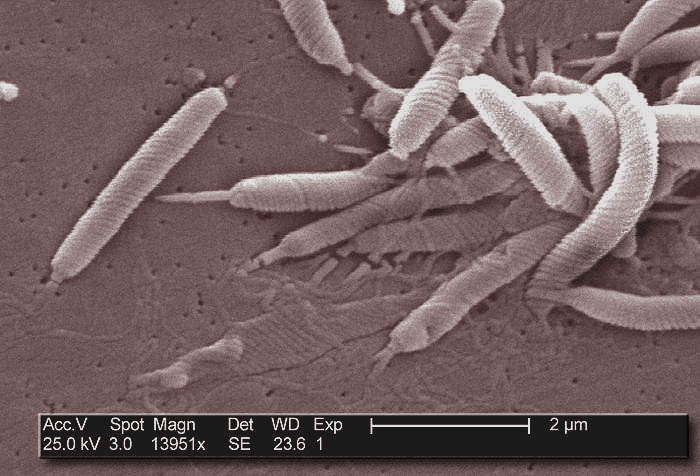
Kingdom
Pseudomonadati
Phylum
Campylobacterota
Class
Epsilonproteobacteria
Order
Campylobacterales
Family
Helicobacteraceae
Genus
Helicobacter
Description
Taxonomy
| Kingdom | Pseudomonadati |
|---|---|
| Phylum | Campylobacterota |
| Class | Epsilonproteobacteria |
| Order | Campylobacterales |
| Family | Helicobacteraceae |
| Genus | Helicobacter |
| Species | Helicobacter pylori |
| Strain | ZH106 |
Profile
| Physiology | |
|---|---|
| Gram staining properties | Negative |
| Shape | Spirilla |
| Mobility | No |
| Flagellar presence | Yes |
| Number of membranes | 2 |

Image source: Wikipedia/Wikimedia
| Ecology, Host, and Life Cycle | |
|---|---|
| Oxygen requirements | Microaerophilic |
| Optimal temperature | 37 |
| Temperature range | Mesophilic |
| Habitat | HostAssociated |
| Biotic relationship | Free living |
| Host(s) | Homo sapiens, Gallus gallus, Aves |
| Cell arrangement | Singles |
| Sporulation | Not Available |
| Energy source | Not Available |
| Pathogenicity | Human |
Gene Summary
Adenine Count
505138 bp
Thymine Count
496690 bp
Guanine Count
324439 bp
Cytosine Count
309253 bp
Genome Length
1638376 bp
Protein-coding Genes
1486 genes
Non-Coding Genes
42 genes
# of Chromosomes/Plasmids
1
Genes
| Name | Locus Tag | UniProt ID | Strand Orientation | Gene Start/End | Protein Molecular Weight |
|---|---|---|---|---|---|
| ybfb/yjij family mfs transporter | EC556_07755 | Not Available | Positive | 1589589 - 1590743 | 42734.7 |
| repb family plasmid replication initiator protein | EC556_07760 | Not Available | Negative | 1590846 - 1592396 | 61118.0 |
| type ia dna topoisomerase | EC556_07765 | Not Available | Positive | 1592823 - 1594299 | 56589.7 |
| virb8 family protein | EC556_07770 | Not Available | Positive | 1594429 - 1595415 | 38172.1 |
| conjugal transfer protein | EC556_07775 | Not Available | Positive | 1595415 - 1596956 | 59866.4 |
| trbi/virb10 family protein | EC556_07780 | Not Available | Positive | 1596953 - 1598188 | 46372.1 |
| hypothetical protein | EC556_07785 | Not Available | Positive | 1598258 - 1598554 | 11801.0 |
| hypothetical protein | EC556_07790 | Not Available | Positive | 1598544 - 1598807 | 10450.6 |
| hypothetical protein | EC556_07795 | Not Available | Positive | 1598804 - 1599103 | 12100.7 |
| duf262 domain-containing protein | EC556_07800 | Not Available | Positive | 1599141 - 1600871 | 68516.3 |
Pathways
1109 pathways
Health Effects
| Health Condition | Relation | Reference |
|---|---|---|
| Chronic gastric inflammation | Causes | PMC10226649 |
| Gastric cancer | Causes | PMC10226649 |
| Gastric ulcers | Causes | PMC10420633 |
| Stomach carcinoma | Causes | PMC10420633 |
| Ulcers | Causes | PMC10420633 |
| Adenocarcinoma | Causes | PMC10420633 |
| Mucosa-associated lymphoid tissue lymphoma | Causes | PMC10420633 |
| Gerd | Causes | PMC10712878 |
| Gastritis | Causes | PMC10712878 |
| Gastric cancer | Causes | PMC10732068 |