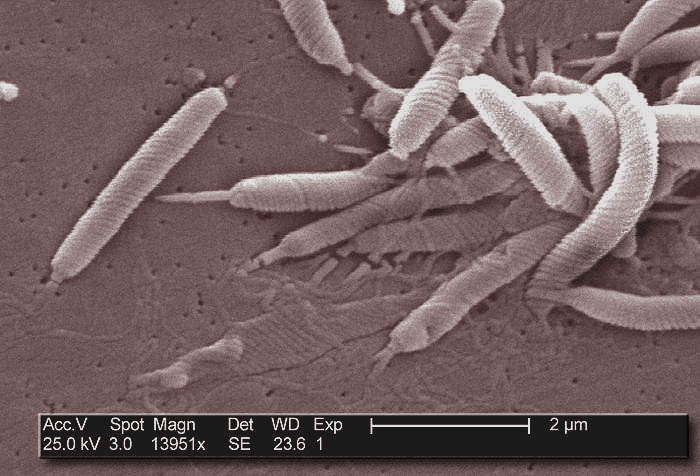
Kingdom
Pseudomonadati
Phylum
Campylobacterota
Class
Epsilonproteobacteria
Order
Campylobacterales
Family
Helicobacteraceae
Genus
Helicobacter
Description
Taxonomy
| Kingdom | Pseudomonadati |
|---|---|
| Phylum | Campylobacterota |
| Class | Epsilonproteobacteria |
| Order | Campylobacterales |
| Family | Helicobacteraceae |
| Genus | Helicobacter |
| Species | Helicobacter pylori |
| Strain | ZH106 |
Profile
| Physiology | |
|---|---|
| Gram staining properties | Negative |
| Shape | Spirilla |
| Mobility | No |
| Flagellar presence | Yes |
| Number of membranes | 2 |

Image source: Wikipedia/Wikimedia
| Ecology, Host, and Life Cycle | |
|---|---|
| Oxygen requirements | Microaerophilic |
| Optimal temperature | 37 |
| Temperature range | Mesophilic |
| Habitat | HostAssociated |
| Biotic relationship | Free living |
| Host(s) | Homo sapiens, Gallus gallus, Aves |
| Cell arrangement | Singles |
| Sporulation | Not Available |
| Energy source | Not Available |
| Pathogenicity | Human |
Gene Summary
Adenine Count
505138 bp
Thymine Count
496690 bp
Guanine Count
324439 bp
Cytosine Count
309253 bp
Genome Length
1638376 bp
Protein-coding Genes
1486 genes
Non-Coding Genes
42 genes
# of Chromosomes/Plasmids
1
Genes
| Name | Locus Tag | UniProt ID | Strand Orientation | Gene Start/End | Protein Molecular Weight |
|---|---|---|---|---|---|
| ribonuclease j | EC556_07600 | Not Available | Negative | 1552274 - 1554352 | 77723.1 |
| 16s rrna (adenine(1518)-n(6)/adenine(1519)-n(6))- dimethyltransferase rsma | EC556_07605 | Not Available | Negative | 1554390 - 1555205 | 30616.8 |
| nickel transporter | EC556_07610 | Not Available | Positive | 1555456 - 1555689 | 9398.25 |
| restriction endonuclease subunit s | EC556_07615 | Not Available | Negative | 1556514 - 1557728 | 46211.9 |
| formyltetrahydrofolate deformylase | EC556_07620 | Not Available | Negative | 1557770 - 1558651 | 33591.3 |
| signal peptide peptidase sppa | EC556_07625 | Not Available | Negative | 1558654 - 1559532 | 32552.9 |
| hypothetical protein | EC556_07630 | Not Available | Positive | 1559603 - 1559863 | 10011.5 |
| tir domain protein | EC556_07635 | Not Available | Positive | 1560113 - 1560784 | 25926.7 |
| hypothetical protein | EC556_07640 | Not Available | Positive | 1560793 - 1562016 | 46537.7 |
| hypothetical protein | EC556_07645 | Not Available | Positive | 1562026 - 1562451 | 16335.4 |
Pathways
1109 pathways
Health Effects
| Health Condition | Relation | Reference |
|---|---|---|
| Chronic gastric inflammation | Causes | PMC10226649 |
| Gastric cancer | Causes | PMC10226649 |
| Gastric ulcers | Causes | PMC10420633 |
| Stomach carcinoma | Causes | PMC10420633 |
| Ulcers | Causes | PMC10420633 |
| Adenocarcinoma | Causes | PMC10420633 |
| Mucosa-associated lymphoid tissue lymphoma | Causes | PMC10420633 |
| Gerd | Causes | PMC10712878 |
| Gastritis | Causes | PMC10712878 |
| Gastric cancer | Causes | PMC10732068 |