Kingdom
Pseudomonadati
Phylum
Campylobacterota
Class
Epsilonproteobacteria
Order
Campylobacterales
Family
Helicobacteraceae
Genus
Helicobacter
Description
Taxonomy
| Kingdom | Pseudomonadati |
|---|---|
| Phylum | Campylobacterota |
| Class | Epsilonproteobacteria |
| Order | Campylobacterales |
| Family | Helicobacteraceae |
| Genus | Helicobacter |
| Species | Helicobacter pylori |
| Strain | 22316 |
Profile
| Physiology | |
|---|---|
| Gram staining properties | Negative |
| Shape | Spirilla |
| Mobility | No |
| Flagellar presence | Yes |
| Number of membranes | 2 |

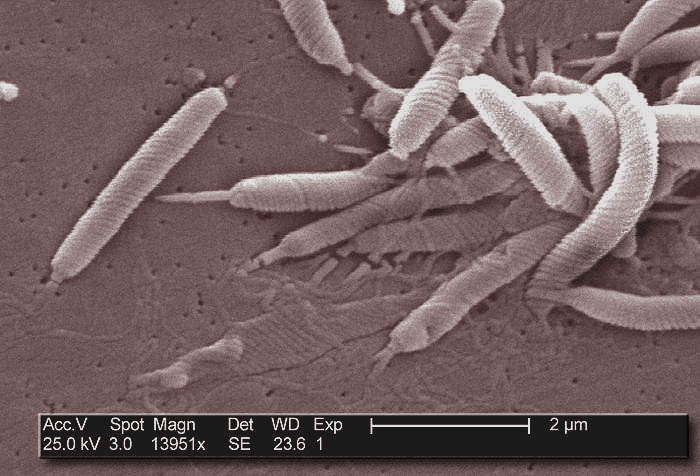
Image source: Wikipedia/Wikimedia
| Ecology, Host, and Life Cycle | |
|---|---|
| Oxygen requirements | Microaerophilic |
| Optimal temperature | 37 |
| Temperature range | Mesophilic |
| Habitat | HostAssociated |
| Biotic relationship | Free living |
| Host(s) | Homo sapiens, Gallus gallus, Aves |
| Cell arrangement | Singles |
| Sporulation | Not Available |
| Energy source | Not Available |
| Pathogenicity | Human |
Gene Summary
Adenine Count
584409 bp
Thymine Count
568954 bp
Guanine Count
367632 bp
Cytosine Count
366447 bp
Genome Length
1887442 bp
Protein-coding Genes
0 genes
Non-Coding Genes
0 genes
# of Chromosomes/Plasmids
1
Genes
| Name | Locus Tag | UniProt ID | Strand Orientation | Gene Start/End | Protein Molecular Weight |
|---|---|---|---|---|---|
| protein-export membrane protein secd | BB424_02535 | Not Available | Positive | 1747546 - 1749123 | 56714.3 |
| protein-export membrane protein secf | BB424_02540 | Not Available | Positive | 1749132 - 1750103 | 36132.9 |
| hypothetical protein | BB424_02545 | Not Available | Positive | 1750113 - 1750451 | 12226.5 |
| leucine--trna ligase | BB424_02550 | Not Available | Positive | 1750461 - 1752881 | 93149.1 |
| hypothetical protein | BB424_02555 | Not Available | Positive | 1752878 - 1753390 | 19729.4 |
| bifunctional folylpolyglutamate synthase/dihydrofolate synthase | BB424_02560 | Not Available | Positive | 1753380 - 1754549 | 44281.7 |
| peptidase m23 | BB424_02565 | Not Available | Positive | 1754549 - 1755475 | 34876.5 |
| peptidase m23 | BB424_02570 | Not Available | Positive | 1755485 - 1756423 | 35585.2 |
| polymer-forming cytoskeletal family protein | BB424_02575 | Not Available | Positive | 1756342 - 1756752 | 14611.7 |
| transcription-repair coupling factor | BB424_02580 | Not Available | Positive | 1756756 - 1759755 | 113173.0 |
Pathways
1109 pathways
Health Effects
| Health Condition | Relation | Reference |
|---|---|---|
| Chronic gastric inflammation | Causes | PMC10226649 |
| Gastric cancer | Causes | PMC10226649 |
| Gastric ulcers | Causes | PMC10420633 |
| Stomach carcinoma | Causes | PMC10420633 |
| Ulcers | Causes | PMC10420633 |
| Adenocarcinoma | Causes | PMC10420633 |
| Mucosa-associated lymphoid tissue lymphoma | Causes | PMC10420633 |
| Gerd | Causes | PMC10712878 |
| Gastritis | Causes | PMC10712878 |
| Gastric cancer | Causes | PMC10732068 |