Kingdom
Pseudomonadati
Phylum
Campylobacterota
Class
Epsilonproteobacteria
Order
Campylobacterales
Family
Helicobacteraceae
Genus
Helicobacter
Description
Taxonomy
| Kingdom | Pseudomonadati |
|---|---|
| Phylum | Campylobacterota |
| Class | Epsilonproteobacteria |
| Order | Campylobacterales |
| Family | Helicobacteraceae |
| Genus | Helicobacter |
| Species | Helicobacter pylori |
| Strain | 1846/05 |
Profile
| Physiology | |
|---|---|
| Gram staining properties | Negative |
| Shape | Spirilla |
| Mobility | No |
| Flagellar presence | Yes |
| Number of membranes | 2 |

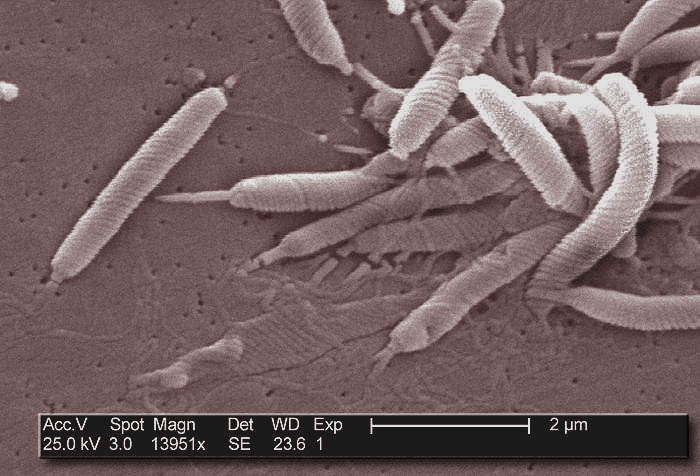
Image source: Wikipedia/Wikimedia
| Ecology, Host, and Life Cycle | |
|---|---|
| Oxygen requirements | Microaerophilic |
| Optimal temperature | 37 |
| Temperature range | Mesophilic |
| Habitat | HostAssociated |
| Biotic relationship | Free living |
| Host(s) | Homo sapiens, Gallus gallus, Aves |
| Cell arrangement | Singles |
| Sporulation | Not Available |
| Energy source | Not Available |
| Pathogenicity | Human |
Genome Summary
Helicobacter pylori strain 1846/05 Contig58, whole genome shotgun
Gene Summary
Adenine Count
499644 bp
Thymine Count
502517 bp
Guanine Count
322326 bp
Cytosine Count
317342 bp
Genome Length
1642077 bp
Protein-coding Genes
1468 genes
Non-Coding Genes
75 genes
# of Chromosomes/Plasmids
2
Genes
| Name | Locus Tag | UniProt ID | Strand Orientation | Gene Start/End | Protein Molecular Weight |
|---|---|---|---|---|---|
| potassium channel protein | HPY1846_04575 | Not Available | Positive | 956755 - 957891 | 42891.0 |
| hypothetical protein | HPY1846_04585 | Not Available | Positive | 958901 - 959102 | 7911.69 |
| glycosyltransferase 9 family protein | HPY1846_04590 | Not Available | Positive | 959068 - 959916 | 33070.0 |
| gtp-binding protein | HPY1846_04595 | Not Available | Positive | 959962 - 961761 | 66723.4 |
| restriction endonuclease | HPY1846_04600 | Not Available | Positive | 961777 - 962706 | 35891.4 |
| restriction endonuclease | HPY1846_04605 | Not Available | Positive | 962709 - 963332 | 23529.9 |
| dna methyltransferase | HPY1846_04610 | Not Available | Positive | 963422 - 964477 | 39612.9 |
| non-functional restriction endonuclease | HPY1846_04615 | Not Available | Positive | 964470 - 965222 | 29427.2 |
| catalase | HPY1846_04620 | Not Available | Negative | 965457 - 966401 | 35911.4 |
| membrane protein | HPY1846_04625 | Not Available | Positive | 966692 - 968278 | 59731.2 |
Pathways
1224 pathways
Health Effects
| Health Condition | Relation | Reference |
|---|---|---|
| Chronic gastric inflammation | Causes | PMC10226649 |
| Gastric cancer | Causes | PMC10226649 |
| Gastric ulcers | Causes | PMC10420633 |
| Stomach carcinoma | Causes | PMC10420633 |
| Ulcers | Causes | PMC10420633 |
| Adenocarcinoma | Causes | PMC10420633 |
| Mucosa-associated lymphoid tissue lymphoma | Causes | PMC10420633 |
| Gerd | Causes | PMC10712878 |
| Gastritis | Causes | PMC10712878 |
| Gastric cancer | Causes | PMC10732068 |