Kingdom
Pseudomonadati
Phylum
Campylobacterota
Class
Epsilonproteobacteria
Order
Campylobacterales
Family
Helicobacteraceae
Genus
Helicobacter
Description
Taxonomy
| Kingdom | Pseudomonadati |
|---|---|
| Phylum | Campylobacterota |
| Class | Epsilonproteobacteria |
| Order | Campylobacterales |
| Family | Helicobacteraceae |
| Genus | Helicobacter |
| Species | Helicobacter pylori |
| Strain | ZH120 |
Profile
| Physiology | |
|---|---|
| Gram staining properties | Negative |
| Shape | Spirilla |
| Mobility | No |
| Flagellar presence | Yes |
| Number of membranes | 2 |

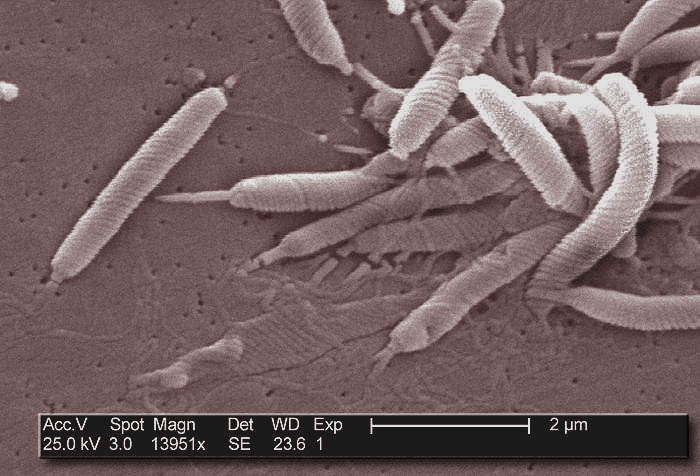
Image source: Wikipedia/Wikimedia
| Ecology, Host, and Life Cycle | |
|---|---|
| Oxygen requirements | Microaerophilic |
| Optimal temperature | 37 |
| Temperature range | Mesophilic |
| Habitat | HostAssociated |
| Biotic relationship | Free living |
| Host(s) | Homo sapiens, Gallus gallus, Aves |
| Cell arrangement | Singles |
| Sporulation | Not Available |
| Energy source | Not Available |
| Pathogenicity | Human |
Gene Summary
Adenine Count
487407 bp
Thymine Count
492404 bp
Guanine Count
307601 bp
Cytosine Count
314574 bp
Genome Length
1605542 bp
Protein-coding Genes
1450 genes
Non-Coding Genes
41 genes
# of Chromosomes/Plasmids
1
Genes
| Name | Locus Tag | UniProt ID | Strand Orientation | Gene Start/End | Protein Molecular Weight |
|---|---|---|---|---|---|
| single-stranded-dna-specific exonuclease recj | EC584_00555 | Not Available | Positive | 111148 - 112698 | 58175.8 |
| hypothetical protein | EC584_00565 | Not Available | Negative | 113680 - 114240 | 22075.9 |
| hypothetical protein | EC584_00570 | Not Available | Negative | 114224 - 114562 | 13651.6 |
| sel1 repeat family protein | EC584_00575 | Not Available | Negative | 114750 - 114926 | 6454.84 |
| sel1 repeat family protein | EC584_00580 | Not Available | Negative | 114947 - 115294 | 12796.6 |
| holliday junction resolvase ruvx | EC584_00585 | Not Available | Negative | 115424 - 115828 | 15145.6 |
| dna-protecting protein dpra | EC584_00590 | Not Available | Negative | 115825 - 116625 | 29919.6 |
| cell division topological specificity factor mine | EC584_00595 | Not Available | Negative | 116640 - 116873 | 8892.88 |
| septum site-determining protein mind | EC584_00600 | Not Available | Negative | 116870 - 117676 | 29321.8 |
| ketol-acid reductoisomerase | EC584_00605 | Not Available | Negative | 117700 - 118692 | 36475.6 |
Pathways
1224 pathways
Health Effects
| Health Condition | Relation | Reference |
|---|---|---|
| Chronic gastric inflammation | Causes | PMC10226649 |
| Gastric cancer | Causes | PMC10226649 |
| Gastric ulcers | Causes | PMC10420633 |
| Stomach carcinoma | Causes | PMC10420633 |
| Ulcers | Causes | PMC10420633 |
| Adenocarcinoma | Causes | PMC10420633 |
| Mucosa-associated lymphoid tissue lymphoma | Causes | PMC10420633 |
| Gerd | Causes | PMC10712878 |
| Gastritis | Causes | PMC10712878 |
| Gastric cancer | Causes | PMC10732068 |