
Kingdom
Pseudomonadati
Phylum
Campylobacterota
Class
Epsilonproteobacteria
Order
Campylobacterales
Family
Helicobacteraceae
Genus
Helicobacter
Description
Taxonomy
| Kingdom | Pseudomonadati |
|---|---|
| Phylum | Campylobacterota |
| Class | Epsilonproteobacteria |
| Order | Campylobacterales |
| Family | Helicobacteraceae |
| Genus | Helicobacter |
| Species | Helicobacter pylori |
| Strain | ZH02 |
Profile
| Physiology | |
|---|---|
| Gram staining properties | Negative |
| Shape | Spirilla |
| Mobility | No |
| Flagellar presence | Yes |
| Number of membranes | 2 |
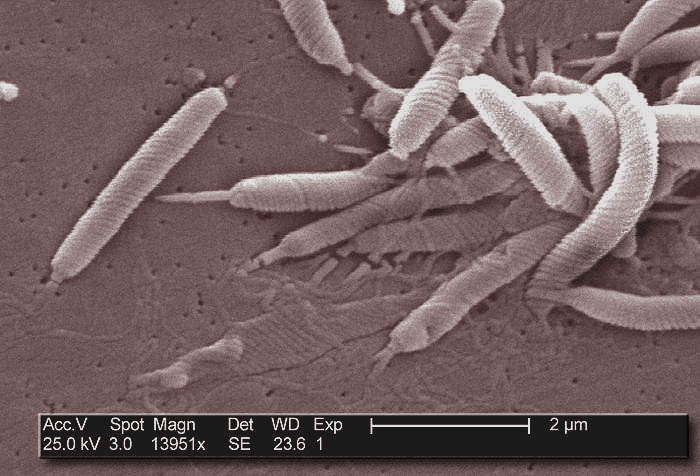
Image source: Wikipedia/Wikimedia
| Ecology, Host, and Life Cycle | |
|---|---|
| Oxygen requirements | Microaerophilic |
| Optimal temperature | 37 |
| Temperature range | Mesophilic |
| Habitat | HostAssociated |
| Biotic relationship | Free living |
| Host(s) | Homo sapiens, Gallus gallus, Aves |
| Cell arrangement | Singles |
| Sporulation | Not Available |
| Energy source | Not Available |
| Pathogenicity | Human |
Gene Summary
Adenine Count
472978 bp
Thymine Count
472060 bp
Guanine Count
300888 bp
Cytosine Count
306565 bp
Genome Length
1554839 bp
Protein-coding Genes
1418 genes
Non-Coding Genes
42 genes
# of Chromosomes/Plasmids
1
Genes
| Name | Locus Tag | UniProt ID | Strand Orientation | Gene Start/End | Protein Molecular Weight |
|---|---|---|---|---|---|
| adenine-specific dna glycosylase | ECB89_00425 | Not Available | Positive | 79101 - 80087 | 37681.1 |
| l-lactate permease | ECB89_00430 | Not Available | Negative | 80111 - 81766 | 59575.6 |
| l-lactate permease | ECB89_00435 | Not Available | Negative | 81822 - 83471 | 59244.4 |
| (fe-s)-binding protein | ECB89_00440 | Not Available | Positive | 83692 - 84420 | 27494.4 |
| iron-sulfur cluster-binding protein | ECB89_00445 | Not Available | Positive | 84449 - 85894 | 54252.6 |
| lactate utilization protein c | ECB89_00450 | Not Available | Positive | 85887 - 86522 | 23565.9 |
| peroxiredoxin | ECB89_00455 | Not Available | Positive | 86532 - 86990 | 17102.8 |
| hypothetical protein | ECB89_00460 | Not Available | Negative | 87233 - 87367 | 5023.17 |
| 3-deoxy-7-phosphoheptulonate synthase class ii | ECB89_00465 | Not Available | Negative | 87656 - 89005 | 50834.4 |
| haaap family serine/threonine permease | ECB89_00470 | Not Available | Positive | 89187 - 90428 | 46282.1 |
Pathways
1109 pathways
Health Effects
| Health Condition | Relation | Reference |
|---|---|---|
| Chronic gastric inflammation | Causes | PMC10226649 |
| Gastric cancer | Causes | PMC10226649 |
| Gastric ulcers | Causes | PMC10420633 |
| Stomach carcinoma | Causes | PMC10420633 |
| Ulcers | Causes | PMC10420633 |
| Adenocarcinoma | Causes | PMC10420633 |
| Mucosa-associated lymphoid tissue lymphoma | Causes | PMC10420633 |
| Gerd | Causes | PMC10712878 |
| Gastritis | Causes | PMC10712878 |
| Gastric cancer | Causes | PMC10732068 |


