
Kingdom
Pseudomonadati
Phylum
Campylobacterota
Class
Epsilonproteobacteria
Order
Campylobacterales
Family
Helicobacteraceae
Genus
Helicobacter
Description
Taxonomy
| Kingdom | Pseudomonadati |
|---|---|
| Phylum | Campylobacterota |
| Class | Epsilonproteobacteria |
| Order | Campylobacterales |
| Family | Helicobacteraceae |
| Genus | Helicobacter |
| Species | Helicobacter pylori |
| Strain | ZH02 |
Profile
| Physiology | |
|---|---|
| Gram staining properties | Negative |
| Shape | Spirilla |
| Mobility | No |
| Flagellar presence | Yes |
| Number of membranes | 2 |
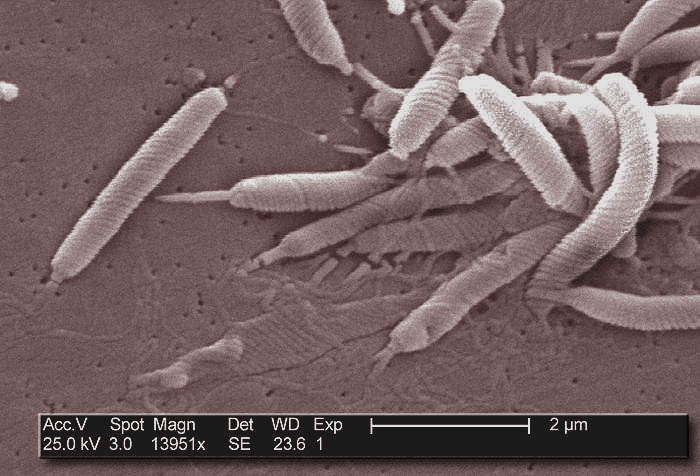
Image source: Wikipedia/Wikimedia
| Ecology, Host, and Life Cycle | |
|---|---|
| Oxygen requirements | Microaerophilic |
| Optimal temperature | 37 |
| Temperature range | Mesophilic |
| Habitat | HostAssociated |
| Biotic relationship | Free living |
| Host(s) | Homo sapiens, Gallus gallus, Aves |
| Cell arrangement | Singles |
| Sporulation | Not Available |
| Energy source | Not Available |
| Pathogenicity | Human |
Gene Summary
Adenine Count
472978 bp
Thymine Count
472060 bp
Guanine Count
300888 bp
Cytosine Count
306565 bp
Genome Length
1554839 bp
Protein-coding Genes
1418 genes
Non-Coding Genes
42 genes
# of Chromosomes/Plasmids
1
Genes
| Name | Locus Tag | UniProt ID | Strand Orientation | Gene Start/End | Protein Molecular Weight |
|---|---|---|---|---|---|
| outer membrane protein | ECB89_07685 | Not Available | Positive | 1543204 - 1545158 | 71034.1 |
| outer membrane protein | ECB89_07690 | Not Available | Positive | 1545266 - 1547090 | 66602.2 |
| hypothetical protein | ECB89_07695 | Not Available | Negative | 1547091 - 1547711 | 24043.6 |
| duf3519 domain-containing protein | ECB89_07700 | Not Available | Negative | 1547854 - 1548607 | 28536.5 |
| outer membrane protein | ECB89_07705 | Not Available | Positive | 1548618 - 1549718 | 41425.5 |
| fucosyltransferase | ECB89_07710 | Not Available | Positive | 1549728 - 1550530 | 30881.2 |
| type ii toxin-antitoxin system hicb family antitoxin | ECB89_07720 | Not Available | Positive | 1551314 - 1551532 | 8071.7 |
| type ii toxin-antitoxin system hica family toxin | ECB89_07725 | Not Available | Positive | 1551525 - 1551719 | 7521.43 |
| cagy like domain protein | ECB89_07730 | Not Available | Negative | 1551748 - 1551823 | 2899.8 |
| cag pathogenicity island protein | ECB89_07735 | Not Available | Negative | 1552027 - 1552119 | 3441.32 |
Pathways
1109 pathways
Health Effects
| Health Condition | Relation | Reference |
|---|---|---|
| Chronic gastric inflammation | Causes | PMC10226649 |
| Gastric cancer | Causes | PMC10226649 |
| Gastric ulcers | Causes | PMC10420633 |
| Stomach carcinoma | Causes | PMC10420633 |
| Ulcers | Causes | PMC10420633 |
| Adenocarcinoma | Causes | PMC10420633 |
| Mucosa-associated lymphoid tissue lymphoma | Causes | PMC10420633 |
| Gerd | Causes | PMC10712878 |
| Gastritis | Causes | PMC10712878 |
| Gastric cancer | Causes | PMC10732068 |


