Kingdom
Pseudomonadati
Phylum
Campylobacterota
Class
Epsilonproteobacteria
Order
Campylobacterales
Family
Helicobacteraceae
Genus
Helicobacter
Description
Taxonomy
| Kingdom | Pseudomonadati |
|---|---|
| Phylum | Campylobacterota |
| Class | Epsilonproteobacteria |
| Order | Campylobacterales |
| Family | Helicobacteraceae |
| Genus | Helicobacter |
| Species | Helicobacter pylori |
| Strain | 3118 |
Profile
| Physiology | |
|---|---|
| Gram staining properties | Negative |
| Shape | Spirilla |
| Mobility | No |
| Flagellar presence | Yes |
| Number of membranes | 2 |

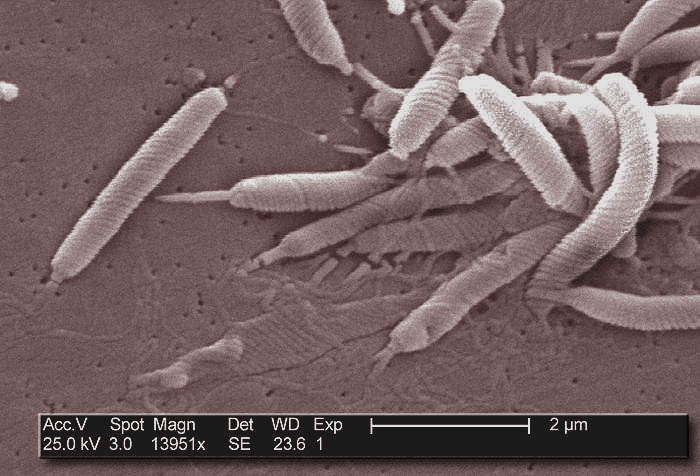
Image source: Wikipedia/Wikimedia
| Ecology, Host, and Life Cycle | |
|---|---|
| Oxygen requirements | Microaerophilic |
| Optimal temperature | 37 |
| Temperature range | Mesophilic |
| Habitat | HostAssociated |
| Biotic relationship | Free living |
| Host(s) | Homo sapiens, Gallus gallus, Aves |
| Cell arrangement | Singles |
| Sporulation | Not Available |
| Energy source | Not Available |
| Pathogenicity | Human |
Gene Summary
Adenine Count
Not Available
Thymine Count
Not Available
Guanine Count
Not Available
Cytosine Count
Not Available
Genome Length
Not Available
Protein-coding Genes
1319 genes
Non-Coding Genes
180 genes
# of Chromosomes/Plasmids
1
Genes
| Name | Locus Tag | UniProt ID | Strand Orientation | Gene Start/End | Protein Molecular Weight |
|---|---|---|---|---|---|
| 3'-5' exonuclease | BB449_04160 | Not Available | Negative | 1409731 - 1410543 | 31633.7 |
| ferrous iron transport protein b | BB449_04165 | Not Available | Positive | 1410686 - 1412614 | 71596.8 |
| ligand-gated channel | BB449_04170 | Not Available | Positive | 1412875 - 1415178 | 87662.9 |
| flagellar biosynthetic protein flip | BB449_04175 | Not Available | Negative | 1415220 - 1415966 | 27843.6 |
| flagellar biosynthesis protein flip | BB449_04180 | Not Available | Negative | 1415999 - 1416091 | 3394.42 |
| udp-n-acetylglucosamine diphosphorylase/glucosamine-1-phosphate n-acetyltransferase | BB449_04185 | Not Available | Positive | 1416048 - 1417349 | 47869.9 |
| pantothenate kinase | BB449_04190 | Not Available | Positive | 1417569 - 1417889 | 11329.5 |
| hypothetical protein | BB449_04195 | Not Available | Positive | 1417929 - 1418432 | 19115.4 |
| ribonucleoside-diphosphate reductase subunit alpha | BB449_04200 | Not Available | Positive | 1418607 - 1420973 | 90248.9 |
| oxidoreductase | BB449_04205 | Not Available | Positive | 1421034 - 1421981 | 36057.3 |
Pathways
1109 pathways
Health Effects
| Health Condition | Relation | Reference |
|---|---|---|
| Chronic gastric inflammation | Causes | PMC10226649 |
| Gastric cancer | Causes | PMC10226649 |
| Gastric ulcers | Causes | PMC10420633 |
| Stomach carcinoma | Causes | PMC10420633 |
| Ulcers | Causes | PMC10420633 |
| Adenocarcinoma | Causes | PMC10420633 |
| Mucosa-associated lymphoid tissue lymphoma | Causes | PMC10420633 |
| Gerd | Causes | PMC10712878 |
| Gastritis | Causes | PMC10712878 |
| Gastric cancer | Causes | PMC10732068 |