Kingdom
Pseudomonadati
Phylum
Campylobacterota
Class
Epsilonproteobacteria
Order
Campylobacterales
Family
Helicobacteraceae
Genus
Helicobacter
Description
Taxonomy
| Kingdom | Pseudomonadati |
|---|---|
| Phylum | Campylobacterota |
| Class | Epsilonproteobacteria |
| Order | Campylobacterales |
| Family | Helicobacteraceae |
| Genus | Helicobacter |
| Species | Helicobacter pylori |
| Strain | 228/99 |
Profile
| Physiology | |
|---|---|
| Gram staining properties | Negative |
| Shape | Spirilla |
| Mobility | No |
| Flagellar presence | Yes |
| Number of membranes | 2 |

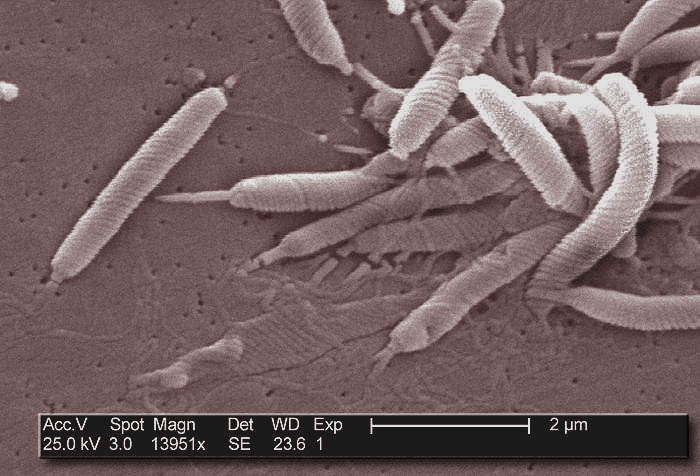
Image source: Wikipedia/Wikimedia
| Ecology, Host, and Life Cycle | |
|---|---|
| Oxygen requirements | Microaerophilic |
| Optimal temperature | 37 |
| Temperature range | Mesophilic |
| Habitat | HostAssociated |
| Biotic relationship | Free living |
| Host(s) | Homo sapiens, Gallus gallus, Aves |
| Cell arrangement | Singles |
| Sporulation | Not Available |
| Energy source | Not Available |
| Pathogenicity | Human |
Genome Summary
Helicobacter pylori strain 228/99 Contig54, whole genome shotgun
Gene Summary
Adenine Count
Not Available
Thymine Count
Not Available
Guanine Count
Not Available
Cytosine Count
Not Available
Genome Length
Not Available
Protein-coding Genes
Not Available
Non-Coding Genes
Not Available
# of Chromosomes/Plasmids
2
Genes
| Name | Locus Tag | UniProt ID | Strand Orientation | Gene Start/End | Protein Molecular Weight |
|---|---|---|---|---|---|
| gtpase | HPY228_00175 | Not Available | Negative | 33730 - 34182 | 16752.2 |
| pseudouridine synthase | HPY228_00180 | Not Available | Positive | 34316 - 35299 | 37712.6 |
| Ncrna_class:rnase_p_rna | Not Available | Not Available | Positive | 34804 - 35121 | Not Available |
| fibronectin | HPY228_00185 | Not Available | Positive | 35262 - 36509 | 47479.4 |
| trna (guanine-n7)-methyltransferase | HPY228_00190 | Not Available | Positive | 36520 - 37701 | 45678.6 |
| abc transporter atp-binding protein | HPY228_00195 | Not Available | Positive | 37698 - 38369 | 25403.8 |
| cell division protein ftsx | HPY228_00200 | Not Available | Positive | 38356 - 39162 | 30837.6 |
| peptidase m23 | HPY228_00205 | Not Available | Positive | 39155 - 40357 | 45988.0 |
| flagellar protein flag | HPY228_00210 | Not Available | Positive | 40450 - 40809 | 13407.1 |
| flagellar capping protein | HPY228_00215 | Not Available | Positive | 40826 - 42883 | 74196.8 |
Pathways
1109 pathways
Health Effects
| Health Condition | Relation | Reference |
|---|---|---|
| Chronic gastric inflammation | Causes | PMC10226649 |
| Gastric cancer | Causes | PMC10226649 |
| Gastric ulcers | Causes | PMC10420633 |
| Stomach carcinoma | Causes | PMC10420633 |
| Ulcers | Causes | PMC10420633 |
| Adenocarcinoma | Causes | PMC10420633 |
| Mucosa-associated lymphoid tissue lymphoma | Causes | PMC10420633 |
| Gerd | Causes | PMC10712878 |
| Gastritis | Causes | PMC10712878 |
| Gastric cancer | Causes | PMC10732068 |