Kingdom
Pseudomonadati
Phylum
Campylobacterota
Class
Epsilonproteobacteria
Order
Campylobacterales
Family
Helicobacteraceae
Genus
Helicobacter
Description
Taxonomy
| Kingdom | Pseudomonadati |
|---|---|
| Phylum | Campylobacterota |
| Class | Epsilonproteobacteria |
| Order | Campylobacterales |
| Family | Helicobacteraceae |
| Genus | Helicobacter |
| Species | Helicobacter pylori |
| Strain | 22402 |
Profile
| Physiology | |
|---|---|
| Gram staining properties | Negative |
| Shape | Spirilla |
| Mobility | No |
| Flagellar presence | Yes |
| Number of membranes | 2 |

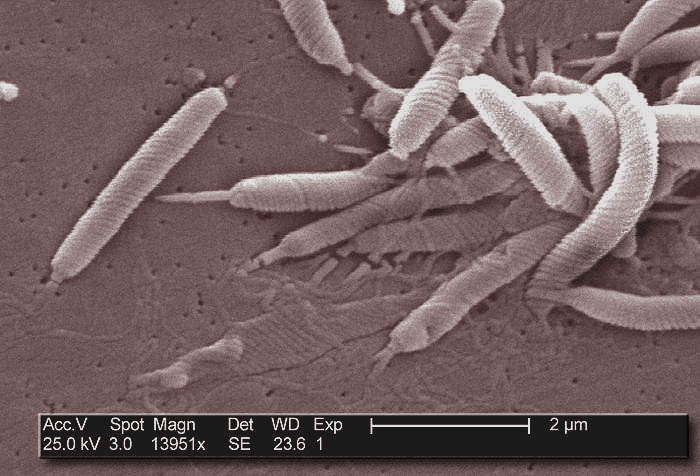
Image source: Wikipedia/Wikimedia
| Ecology, Host, and Life Cycle | |
|---|---|
| Oxygen requirements | Microaerophilic |
| Optimal temperature | 37 |
| Temperature range | Mesophilic |
| Habitat | HostAssociated |
| Biotic relationship | Free living |
| Host(s) | Homo sapiens, Gallus gallus, Aves |
| Cell arrangement | Singles |
| Sporulation | Not Available |
| Energy source | Not Available |
| Pathogenicity | Human |
Gene Summary
Adenine Count
496324 bp
Thymine Count
497859 bp
Guanine Count
313681 bp
Cytosine Count
320344 bp
Genome Length
1628208 bp
Protein-coding Genes
1448 genes
Non-Coding Genes
42 genes
# of Chromosomes/Plasmids
1
Genes
| Name | Locus Tag | UniProt ID | Strand Orientation | Gene Start/End | Protein Molecular Weight |
|---|---|---|---|---|---|
| 23s ribosomal rna | Not Available | Not Available | Positive | 43815 - 46701 | Not Available |
| hypothetical protein | BB392_00245 | Not Available | Negative | 43704 - 44993 | 49502.0 |
| hypothetical protein | BB392_00250 | Not Available | Negative | 45276 - 45542 | 10086.3 |
| bifunctional aconitate hydratase 2/2-methylisocitrate dehydratase | BB392_00255 | Not Available | Negative | 45624 - 48182 | 92608.6 |
| menaquinone biosynthesis protein | BB392_00260 | Not Available | Positive | 48313 - 48996 | 26704.8 |
| ump kinase | BB392_00265 | Not Available | Positive | 49104 - 49826 | 26174.0 |
| dna-directed rna polymerase subunit omega | BB392_00270 | Not Available | Positive | 49868 - 50092 | 8505.4 |
| penta-phosphate guanosine-3'-pyrophosphohydrolase | BB392_00275 | Not Available | Positive | 50079 - 52406 | 89034.6 |
| tyrosine--trna ligase | BB392_00280 | Not Available | Positive | 52430 - 53638 | 45787.4 |
| 2-nitropropane dioxygenase | BB392_00285 | Not Available | Positive | 53655 - 54746 | 39635.2 |
Pathways
1109 pathways
Health Effects
| Health Condition | Relation | Reference |
|---|---|---|
| Chronic gastric inflammation | Causes | PMC10226649 |
| Gastric cancer | Causes | PMC10226649 |
| Gastric ulcers | Causes | PMC10420633 |
| Stomach carcinoma | Causes | PMC10420633 |
| Ulcers | Causes | PMC10420633 |
| Adenocarcinoma | Causes | PMC10420633 |
| Mucosa-associated lymphoid tissue lymphoma | Causes | PMC10420633 |
| Gerd | Causes | PMC10712878 |
| Gastritis | Causes | PMC10712878 |
| Gastric cancer | Causes | PMC10732068 |