Kingdom
Pseudomonadati
Phylum
Campylobacterota
Class
Epsilonproteobacteria
Order
Campylobacterales
Family
Helicobacteraceae
Genus
Helicobacter
Description
Taxonomy
| Kingdom | Pseudomonadati |
|---|---|
| Phylum | Campylobacterota |
| Class | Epsilonproteobacteria |
| Order | Campylobacterales |
| Family | Helicobacteraceae |
| Genus | Helicobacter |
| Species | Helicobacter pylori |
| Strain | 2061 |
Profile
| Physiology | |
|---|---|
| Gram staining properties | Negative |
| Shape | Spirilla |
| Mobility | No |
| Flagellar presence | Yes |
| Number of membranes | 2 |

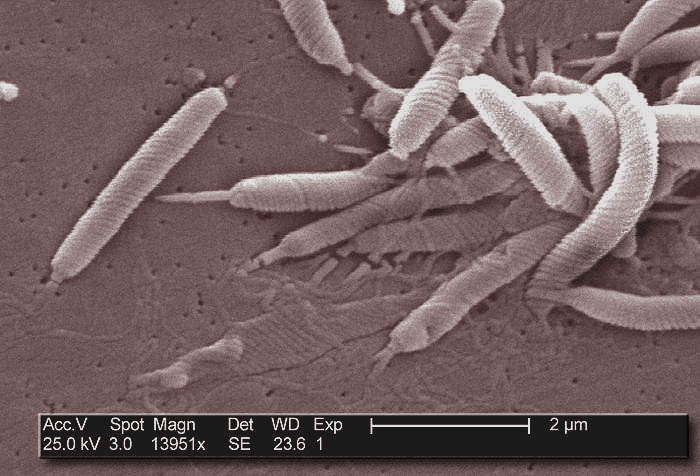
Image source: Wikipedia/Wikimedia
| Ecology, Host, and Life Cycle | |
|---|---|
| Oxygen requirements | Microaerophilic |
| Optimal temperature | 37 |
| Temperature range | Mesophilic |
| Habitat | HostAssociated |
| Biotic relationship | Free living |
| Host(s) | Homo sapiens, Gallus gallus, Aves |
| Cell arrangement | Singles |
| Sporulation | Not Available |
| Energy source | Not Available |
| Pathogenicity | Human |
Gene Summary
Adenine Count
491456 bp
Thymine Count
487179 bp
Guanine Count
319348 bp
Cytosine Count
308731 bp
Genome Length
1606714 bp
Protein-coding Genes
1443 genes
Non-Coding Genes
42 genes
# of Chromosomes/Plasmids
1
Genes
| Name | Locus Tag | UniProt ID | Strand Orientation | Gene Start/End | Protein Molecular Weight |
|---|---|---|---|---|---|
| glycerol-3-phosphate acyltransferase | BB461_00210 | Not Available | Negative | 40017 - 40679 | 23833.3 |
| cytochrome c oxidase accessory protein ccog | BB461_00215 | Not Available | Positive | 40785 - 42161 | 52762.2 |
| saccharopine dehydrogenase | BB461_00220 | Not Available | Negative | 42171 - 43370 | 45141.4 |
| sodium/glutamate symporter | BB461_00225 | Not Available | Positive | 43456 - 44682 | 43888.0 |
| bifunctional diaminohydroxyphosphoribosylaminopyrimidine deaminase/5-amino-6-(5-phosphoribosylamino)uracil reductase | BB461_00230 | Not Available | Positive | 44679 - 45713 | 39181.7 |
| methyltransferase | BB461_00235 | Not Available | Positive | 45695 - 46411 | 26680.6 |
| carbonate dehydratase | BB461_00240 | Not Available | Positive | 46437 - 48773 | 85879.6 |
| copper resistance protein copd | BB461_00245 | Not Available | Negative | 48770 - 49207 | 16318.2 |
| hypothetical protein | BB461_00250 | Not Available | Positive | 49422 - 50552 | 41385.0 |
| hypothetical protein | BB461_00255 | Not Available | Positive | 50723 - 50794 | 2645.02 |
Pathways
1109 pathways
Health Effects
| Health Condition | Relation | Reference |
|---|---|---|
| Chronic gastric inflammation | Causes | PMC10226649 |
| Gastric cancer | Causes | PMC10226649 |
| Gastric ulcers | Causes | PMC10420633 |
| Stomach carcinoma | Causes | PMC10420633 |
| Ulcers | Causes | PMC10420633 |
| Adenocarcinoma | Causes | PMC10420633 |
| Mucosa-associated lymphoid tissue lymphoma | Causes | PMC10420633 |
| Gerd | Causes | PMC10712878 |
| Gastritis | Causes | PMC10712878 |
| Gastric cancer | Causes | PMC10732068 |