Kingdom
Pseudomonadati
Phylum
Pseudomonadota
Class
Gammaproteobacteria
Order
Enterobacterales
Family
Enterobacteriaceae
Genus
Salmonella
Description
Taxonomy
| Kingdom | Pseudomonadati |
|---|---|
| Phylum | Pseudomonadota |
| Class | Gammaproteobacteria |
| Order | Enterobacterales |
| Family | Enterobacteriaceae |
| Genus | Salmonella |
| Species | Salmonella enterica |
| Strain | subsp. enterica serovar 4 |
Profile
| Physiology | |
|---|---|
| Gram staining properties | Negative |
| Shape | Spirilla |
| Mobility | No |
| Flagellar presence | Yes |
| Number of membranes | 2 |

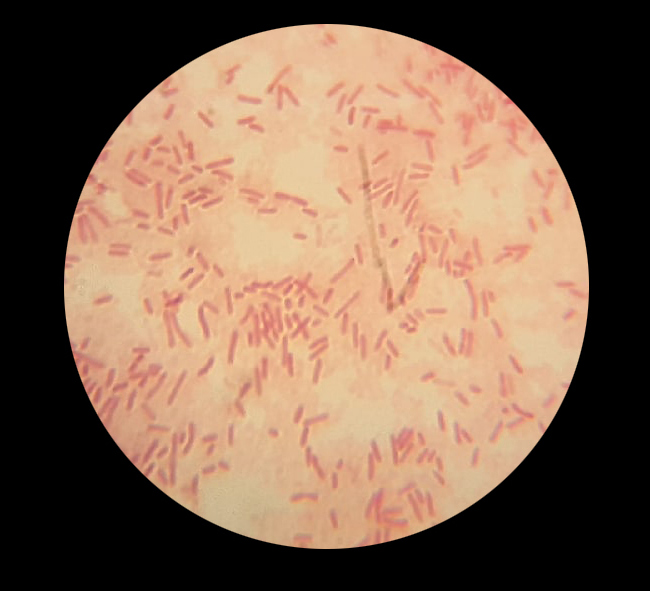
Image source: Wikipedia/Wikimedia
| Ecology, Host, and Life Cycle | |
|---|---|
| Oxygen requirements | Microaerophilic |
| Optimal temperature | 37 |
| Temperature range | Mesophilic |
| Habitat | HostAssociated |
| Biotic relationship | Free living |
| Host(s) | Homo sapiens |
| Cell arrangement | Chains - Singles |
| Sporulation | Not Available |
| Energy source | Chemoorganotroph |
| Pathogenicity | Not Available |
Genome Summary
Salmonella enterica subsp. enterica serovar 4,[5],12:i:- strain
Gene Summary
Adenine Count
1193403 bp
Thymine Count
1192171 bp
Guanine Count
1299730 bp
Cytosine Count
1298899 bp
Genome Length
4984203 bp
Protein-coding Genes
4783 genes
Non-Coding Genes
320 genes
# of Chromosomes/Plasmids
3
Genes
| Name | Locus Tag | UniProt ID | Strand Orientation | Gene Start/End | Protein Molecular Weight |
|---|---|---|---|---|---|
| transcriptional regulator hexr | DBP43_14665 | Not Available | Positive | 2856120 - 2856989 | 32023.6 |
| pyruvate kinase ii | DBP43_14670 | Not Available | Positive | 2857113 - 2858555 | 51390.3 |
| lauroyl-kdo(2)-lipid iv(a) myristoyltransferase | DBP43_14675 | Not Available | Negative | 2858628 - 2859599 | 37289.3 |
| hypothetical protein | DBP43_14680 | Not Available | Positive | 2859598 - 2859825 | 7799.31 |
| murein dd-endopeptidase mepm | DBP43_14685 | Not Available | Negative | 2859716 - 2861035 | 48971.6 |
| zinc abc transporter substrate-binding protein znua | DBP43_14690 | Not Available | Negative | 2861051 - 2862010 | 34796.4 |
| mn2+/zn2+abc transporter atp-binding protein | DBP43_14695 | Not Available | Positive | 2862074 - 2862829 | 27668.0 |
| zinc abc transporter permease subunit znub | DBP43_14700 | Not Available | Positive | 2862826 - 2863611 | 27777.5 |
| holliday junction branch migration dna helicase ruvb | DBP43_14705 | Not Available | Negative | 2863690 - 2864700 | 37020.9 |
| holliday junction branch migration protein ruva | DBP43_14710 | Not Available | Negative | 2864709 - 2865320 | 22147.1 |
Pathways
1080 pathways