Kingdom
Pseudomonadati
Phylum
Spirochaetota
Class
Spirochaetia
Order
Spirochaetales
Family
Treponemataceae
Genus
Treponema
Description
Taxonomy
| Kingdom | Pseudomonadati |
|---|---|
| Phylum | Spirochaetota |
| Class | Spirochaetia |
| Order | Spirochaetales |
| Family | Treponemataceae |
| Genus | Treponema |
| Species | Treponema sp. |
| Strain | No strain |
Profile
| Physiology | |
|---|---|
| Gram staining properties | Negative |
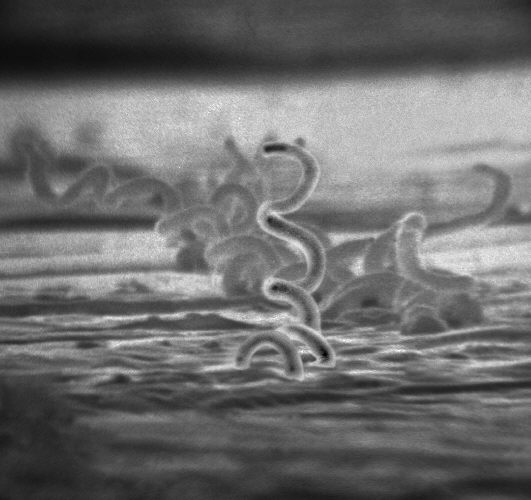
| Shape | Spirilla |
| Mobility | Yes |
| Flagellar presence | Yes |
| Number of membranes | Not Available |

Image source: Wikipedia/Wikimedia
| Ecology, Host, and Life Cycle | |
|---|---|
| Oxygen requirements | Anaerobic |
| Optimal temperature | Not Available |
| Temperature range | Not Available |
| Habitat | Multiple |
| Biotic relationship | Not Available |
| Host(s) | Homo sapiens |
| Cell arrangement | Filaments |
| Sporulation | Nonsporulating |
| Energy source | Chemoheterotroph |
| Pathogenicity | Not Available |
Genome Summary
MAG TPA_asm: Treponema sp. isolate UBA12037 contig_1652, whole
Gene Summary
Adenine Count
937238 bp
Thymine Count
935457 bp
Guanine Count
1494996 bp
Cytosine Count
1493830 bp
Genome Length
4863556 bp
Protein-coding Genes
4259 genes
Non-Coding Genes
48 genes
# of Chromosomes/Plasmids
2
Genes
| Name | Locus Tag | UniProt ID | Strand Orientation | Gene Start/End | Protein Molecular Weight |
|---|---|---|---|---|---|
| abc transporter atp-binding protein | CR988_03765 | Not Available | Negative | 859595 - 861418 | 67597.6 |
| abc transporter permease | CR988_03770 | Not Available | Negative | 861425 - 863224 | 67730.4 |
| abc transporter permease | CR988_03775 | Not Available | Negative | 863626 - 864966 | 49251.4 |
| lipoprotein-releasing system atp-binding protein lold | CR988_03780 | Not Available | Negative | 864963 - 865643 | 24935.0 |
| hypothetical protein | CR988_03785 | Not Available | Negative | 865636 - 866916 | 47705.1 |
| hypothetical protein | CR988_03790 | Not Available | Negative | 866913 - 867614 | 27333.1 |
| signal recognition particle-docking protein ftsy | CR988_03795 | Not Available | Negative | 867617 - 868495 | 32116.8 |
| hypothetical protein | CR988_03800 | Not Available | Negative | 868499 - 869995 | 57295.9 |
| peptide chain release factor 2 | CR988_03805 | Not Available | Negative | 869989 - 871120 | 42890.5 |
| hypothetical protein | CR988_03810 | Not Available | Negative | 871506 - 872996 | 57327.1 |
Pathways
0 pathways
No pathways found
No metabolic pathways have been associated with this bacterium yet.
Health Effects
No health effects information available for this bacterium.