Kingdom
Pseudomonadati
Phylum
Spirochaetota
Class
Spirochaetia
Order
Spirochaetales
Family
Treponemataceae
Genus
Treponema
Description
Taxonomy
| Kingdom | Pseudomonadati |
|---|---|
| Phylum | Spirochaetota |
| Class | Spirochaetia |
| Order | Spirochaetales |
| Family | Treponemataceae |
| Genus | Treponema |
| Species | Treponema sp. |
| Strain | No strain |
Profile
| Physiology | |
|---|---|
| Gram staining properties | Negative |
| Shape | Spirilla |
| Mobility | Yes |
| Flagellar presence | Yes |
| Number of membranes | Not Available |

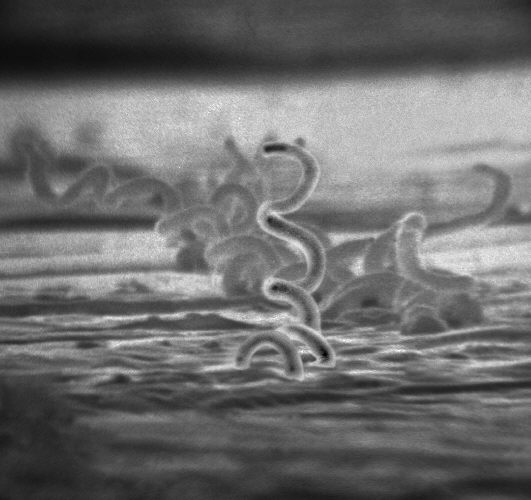
Image source: Wikipedia/Wikimedia
| Ecology, Host, and Life Cycle | |
|---|---|
| Oxygen requirements | Anaerobic |
| Optimal temperature | Not Available |
| Temperature range | Not Available |
| Habitat | Multiple |
| Biotic relationship | Not Available |
| Host(s) | Homo sapiens |
| Cell arrangement | Filaments |
| Sporulation | Nonsporulating |
| Energy source | Chemoheterotroph |
| Pathogenicity | Not Available |
Genome Summary
MAG TPA_asm: Treponema sp. isolate UBA12037 contig_1652, whole
Gene Summary
Adenine Count
937238 bp
Thymine Count
935457 bp
Guanine Count
1494996 bp
Cytosine Count
1493830 bp
Genome Length
4863556 bp
Protein-coding Genes
4259 genes
Non-Coding Genes
48 genes
# of Chromosomes/Plasmids
2
Genes
| Name | Locus Tag | UniProt ID | Strand Orientation | Gene Start/End | Protein Molecular Weight |
|---|---|---|---|---|---|
| hypothetical protein | DIC34_18100 | Not Available | Positive | 3995766 - 3997367 | 55773.5 |
| hypothetical protein | DIC34_18105 | Not Available | Positive | 3997386 - 4000079 | 96643.0 |
| atp-dependent dna helicase recq | DIC34_18110 | Not Available | Positive | 4000154 - 4001785 | 59640.6 |
| molybdopterin oxidoreductase | DIC34_18115 | Not Available | Negative | 4001828 - 4002193 | 12790.9 |
| pyridine nucleotide-disulfide oxidoreductase | DIC34_18120 | Not Available | Negative | 4002187 - 4003422 | 44033.0 |
| fad/nad(p)-binding oxidoreductase | DIC34_18125 | Not Available | Negative | 4003427 - 4004881 | 52723.6 |
| hypothetical protein | DIC34_18130 | Not Available | Positive | 4004944 - 4005924 | 36828.6 |
| hypothetical protein | DIC34_18135 | Not Available | Negative | 4005930 - 4007027 | 41021.5 |
| hypothetical protein | DIC34_18140 | Not Available | Negative | 4007017 - 4008330 | 46899.0 |
| enolase | DIC34_18145 | Not Available | Negative | 4008327 - 4009454 | 40587.3 |
Pathways
0 pathways
No pathways found
No metabolic pathways have been associated with this bacterium yet.
Health Effects
No health effects information available for this bacterium.