Kingdom
Pseudomonadati
Phylum
Spirochaetota
Class
Spirochaetia
Order
Spirochaetales
Family
Treponemataceae
Genus
Treponema
Description
Taxonomy
| Kingdom | Pseudomonadati |
|---|---|
| Phylum | Spirochaetota |
| Class | Spirochaetia |
| Order | Spirochaetales |
| Family | Treponemataceae |
| Genus | Treponema |
| Species | Treponema sp. |
| Strain | No strain |
Profile
| Physiology | |
|---|---|
| Gram staining properties | Negative |
| Shape | Spirilla |
| Mobility | Yes |
| Flagellar presence | Yes |
| Number of membranes | Not Available |

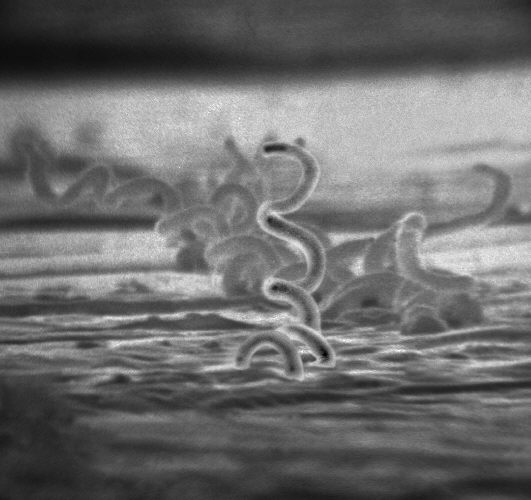
Image source: Wikipedia/Wikimedia
| Ecology, Host, and Life Cycle | |
|---|---|
| Oxygen requirements | Anaerobic |
| Optimal temperature | Not Available |
| Temperature range | Not Available |
| Habitat | Multiple |
| Biotic relationship | Not Available |
| Host(s) | Homo sapiens |
| Cell arrangement | Filaments |
| Sporulation | Nonsporulating |
| Energy source | Chemoheterotroph |
| Pathogenicity | Not Available |
Genome Summary
MAG TPA_asm: Treponema sp. isolate UBA12037 contig_1652, whole
Gene Summary
Adenine Count
937238 bp
Thymine Count
935457 bp
Guanine Count
1494996 bp
Cytosine Count
1493830 bp
Genome Length
4863556 bp
Protein-coding Genes
4259 genes
Non-Coding Genes
48 genes
# of Chromosomes/Plasmids
2
Genes
| Name | Locus Tag | UniProt ID | Strand Orientation | Gene Start/End | Protein Molecular Weight |
|---|---|---|---|---|---|
| hypothetical protein | DIC34_17645 | Not Available | Negative | 3898614 - 3899228 | 21716.9 |
| mbl fold metallo-hydrolase | DIC34_17650 | Not Available | Positive | 3899315 - 3900115 | 28710.3 |
| 50s ribosomal protein l28 | DIC34_17655 | Not Available | Negative | 3900214 - 3900405 | 7195.95 |
| mind/para family protein | DIC34_17660 | Not Available | Positive | 3900536 - 3901561 | 36431.2 |
| trna (adenosine(37)-n6)-threonylcarbamoyltransferase complex transferase subunit tsad | DIC34_17665 | Not Available | Negative | 3901542 - 3902555 | 36241.3 |
| hypothetical protein | DIC34_17670 | Not Available | Negative | 3902536 - 3903723 | 41712.1 |
| rna polymerase subunit sigma-70 | DIC34_17675 | Not Available | Negative | 3903737 - 3904579 | 32705.6 |
| hypothetical protein | DIC34_17680 | Not Available | Positive | 3904825 - 3905268 | 17343.6 |
| hypothetical protein | DIC34_17685 | Not Available | Positive | 3905225 - 3905776 | 19503.4 |
| ammecr1 domain-containing protein | DIC34_17690 | Not Available | Positive | 3905813 - 3906373 | 20544.5 |
Pathways
0 pathways
No pathways found
No metabolic pathways have been associated with this bacterium yet.
Health Effects
No health effects information available for this bacterium.