Kingdom
Pseudomonadati
Phylum
Spirochaetota
Class
Spirochaetia
Order
Spirochaetales
Family
Treponemataceae
Genus
Treponema
Description
Taxonomy
| Kingdom | Pseudomonadati |
|---|---|
| Phylum | Spirochaetota |
| Class | Spirochaetia |
| Order | Spirochaetales |
| Family | Treponemataceae |
| Genus | Treponema |
| Species | Treponema sp. |
| Strain | No strain |
Profile
| Physiology | |
|---|---|
| Gram staining properties | Negative |
| Shape | Spirilla |
| Mobility | Yes |
| Flagellar presence | Yes |
| Number of membranes | Not Available |

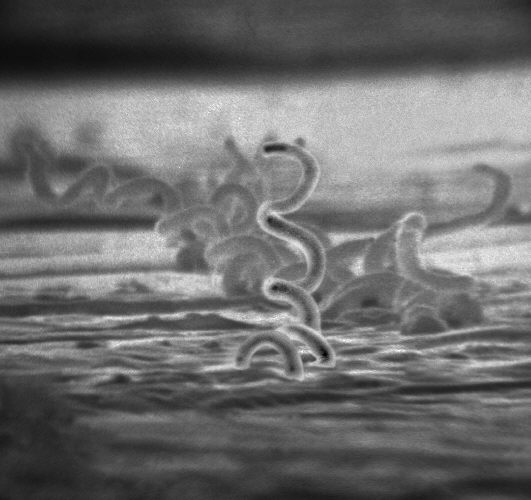
Image source: Wikipedia/Wikimedia
| Ecology, Host, and Life Cycle | |
|---|---|
| Oxygen requirements | Anaerobic |
| Optimal temperature | Not Available |
| Temperature range | Not Available |
| Habitat | Multiple |
| Biotic relationship | Not Available |
| Host(s) | Homo sapiens |
| Cell arrangement | Filaments |
| Sporulation | Nonsporulating |
| Energy source | Chemoheterotroph |
| Pathogenicity | Not Available |
Genome Summary
MAG TPA_asm: Treponema sp. isolate UBA12037 contig_1652, whole
Gene Summary
Adenine Count
937238 bp
Thymine Count
935457 bp
Guanine Count
1494996 bp
Cytosine Count
1493830 bp
Genome Length
4863556 bp
Protein-coding Genes
4259 genes
Non-Coding Genes
48 genes
# of Chromosomes/Plasmids
2
Genes
| Name | Locus Tag | UniProt ID | Strand Orientation | Gene Start/End | Protein Molecular Weight |
|---|---|---|---|---|---|
| hypothetical protein | DIC34_14475 | Not Available | Negative | 3230141 - 3231226 | 39376.4 |
| hypothetical protein | DIC34_14480 | Not Available | Positive | 3231354 - 3232109 | 27328.3 |
| mfs transporter | DIC34_14485 | Not Available | Negative | 3232225 - 3233430 | 43978.1 |
| chromate resistance protein | DIC34_14490 | Not Available | Negative | 3233447 - 3233881 | 15562.5 |
| hypothetical protein | DIC34_14495 | Not Available | Negative | 3233885 - 3234127 | 8857.02 |
| deaminase | DIC34_14500 | Not Available | Negative | 3234277 - 3234924 | 23723.4 |
| hypothetical protein | DIC34_14510 | Not Available | Negative | 3235536 - 3236339 | 29419.0 |
| hypothetical protein | DIC34_14515 | Not Available | Negative | 3236456 - 3237253 | 29252.8 |
| hypothetical protein | DIC34_14520 | Not Available | Negative | 3237354 - 3237869 | 19104.6 |
| hypothetical protein | DIC34_14525 | Not Available | Negative | 3238042 - 3238902 | 32275.0 |
Pathways
0 pathways
No pathways found
No metabolic pathways have been associated with this bacterium yet.
Health Effects
No health effects information available for this bacterium.