Kingdom
Pseudomonadati
Phylum
Spirochaetota
Class
Spirochaetia
Order
Spirochaetales
Family
Treponemataceae
Genus
Treponema
Description
Taxonomy
| Kingdom | Pseudomonadati |
|---|---|
| Phylum | Spirochaetota |
| Class | Spirochaetia |
| Order | Spirochaetales |
| Family | Treponemataceae |
| Genus | Treponema |
| Species | Treponema sp. |
| Strain | No strain |
Profile
| Physiology | |
|---|---|
| Gram staining properties | Negative |
| Shape | Spirilla |
| Mobility | Yes |
| Flagellar presence | Yes |
| Number of membranes | Not Available |

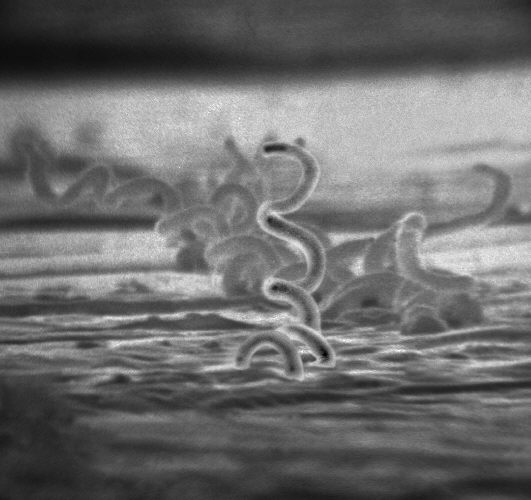
Image source: Wikipedia/Wikimedia
| Ecology, Host, and Life Cycle | |
|---|---|
| Oxygen requirements | Anaerobic |
| Optimal temperature | Not Available |
| Temperature range | Not Available |
| Habitat | Multiple |
| Biotic relationship | Not Available |
| Host(s) | Homo sapiens |
| Cell arrangement | Filaments |
| Sporulation | Nonsporulating |
| Energy source | Chemoheterotroph |
| Pathogenicity | Not Available |
Genome Summary
MAG TPA_asm: Treponema sp. isolate UBA12037 contig_1652, whole
Gene Summary
Adenine Count
937238 bp
Thymine Count
935457 bp
Guanine Count
1494996 bp
Cytosine Count
1493830 bp
Genome Length
4863556 bp
Protein-coding Genes
4259 genes
Non-Coding Genes
48 genes
# of Chromosomes/Plasmids
2
Genes
| Name | Locus Tag | UniProt ID | Strand Orientation | Gene Start/End | Protein Molecular Weight |
|---|---|---|---|---|---|
| epimerase | DIC34_12330 | Not Available | Negative | 2741285 - 2742373 | 39080.1 |
| oxidoreductase | DIC34_12335 | Not Available | Negative | 2742467 - 2743651 | 43469.8 |
| hypothetical protein | DIC34_12345 | Not Available | Negative | 2745113 - 2745376 | 9871.42 |
| putative manganese-dependent inorganic diphosphatase | DIC34_12350 | Not Available | Positive | 2745377 - 2747032 | 61197.6 |
| atp-dependent clp protease proteolytic subunit | DIC34_12355 | Not Available | Positive | 2747130 - 2747750 | 23331.2 |
| formylglycine-generating enzyme family protein | DIC34_12360 | Not Available | Positive | 2747761 - 2748666 | 33108.6 |
| hypothetical protein | DIC34_12365 | Not Available | Negative | 2748663 - 2748992 | 11795.0 |
| coa-disulfide reductase | DIC34_12370 | Not Available | Positive | 2749136 - 2749800 | 23961.9 |
| malonate-semialdehyde dehydrogenase | DIC34_12375 | Not Available | Negative | 2749801 - 2750630 | 29776.2 |
| hypothetical protein | DIC34_12380 | Not Available | Negative | 2751232 - 2754195 | 105267.0 |
Pathways
0 pathways
No pathways found
No metabolic pathways have been associated with this bacterium yet.
Health Effects
No health effects information available for this bacterium.