Kingdom
Pseudomonadati
Phylum
Spirochaetota
Class
Spirochaetia
Order
Spirochaetales
Family
Treponemataceae
Genus
Treponema
Description
Taxonomy
| Kingdom | Pseudomonadati |
|---|---|
| Phylum | Spirochaetota |
| Class | Spirochaetia |
| Order | Spirochaetales |
| Family | Treponemataceae |
| Genus | Treponema |
| Species | Treponema sp. |
| Strain | No strain |
Profile
| Physiology | |
|---|---|
| Gram staining properties | Negative |
| Shape | Spirilla |
| Mobility | Yes |
| Flagellar presence | Yes |
| Number of membranes | Not Available |

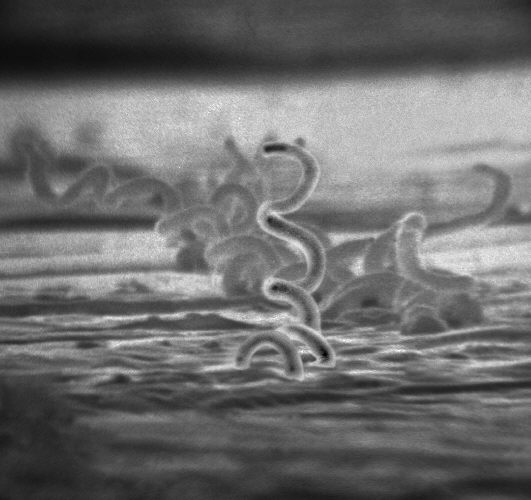
Image source: Wikipedia/Wikimedia
| Ecology, Host, and Life Cycle | |
|---|---|
| Oxygen requirements | Anaerobic |
| Optimal temperature | Not Available |
| Temperature range | Not Available |
| Habitat | Multiple |
| Biotic relationship | Not Available |
| Host(s) | Homo sapiens |
| Cell arrangement | Filaments |
| Sporulation | Nonsporulating |
| Energy source | Chemoheterotroph |
| Pathogenicity | Not Available |
Genome Summary
MAG TPA_asm: Treponema sp. isolate UBA12037 contig_1652, whole
Gene Summary
Adenine Count
937238 bp
Thymine Count
935457 bp
Guanine Count
1494996 bp
Cytosine Count
1493830 bp
Genome Length
4863556 bp
Protein-coding Genes
4259 genes
Non-Coding Genes
48 genes
# of Chromosomes/Plasmids
2
Genes
| Name | Locus Tag | UniProt ID | Strand Orientation | Gene Start/End | Protein Molecular Weight |
|---|---|---|---|---|---|
| hypothetical protein | DIC34_11925 | Not Available | Negative | 2648827 - 2652552 | 129680.0 |
| hypothetical protein | DIC34_11930 | Not Available | Negative | 2652552 - 2656970 | 158864.0 |
| hypothetical protein | DIC34_11935 | Not Available | Negative | 2656982 - 2659054 | 74570.1 |
| 4-hydroxy-3-methylbut-2-enyl diphosphate reductase | DIC34_11940 | Not Available | Negative | 2659140 - 2660003 | 30291.5 |
| protein translocase subunit secf | DIC34_11945 | Not Available | Negative | 2660127 - 2661365 | 44316.0 |
| protein translocase subunit secd | DIC34_11950 | Not Available | Negative | 2661366 - 2663093 | 62913.3 |
| preprotein translocase subunit yajc | DIC34_11955 | Not Available | Negative | 2663219 - 2663668 | 15934.4 |
| hypothetical protein | DIC34_11960 | Not Available | Negative | 2663762 - 2664052 | 10537.6 |
| rubredoxin | DIC34_11965 | Not Available | Negative | 2664235 - 2664396 | 5628.54 |
| desulfoferrodoxin | DIC34_11970 | Not Available | Negative | 2664419 - 2664793 | 13616.4 |
Pathways
0 pathways
No pathways found
No metabolic pathways have been associated with this bacterium yet.
Health Effects
No health effects information available for this bacterium.