Kingdom
Pseudomonadati
Phylum
Spirochaetota
Class
Spirochaetia
Order
Spirochaetales
Family
Treponemataceae
Genus
Treponema
Description
Taxonomy
| Kingdom | Pseudomonadati |
|---|---|
| Phylum | Spirochaetota |
| Class | Spirochaetia |
| Order | Spirochaetales |
| Family | Treponemataceae |
| Genus | Treponema |
| Species | Treponema sp. |
| Strain | No strain |
Profile
| Physiology | |
|---|---|
| Gram staining properties | Negative |
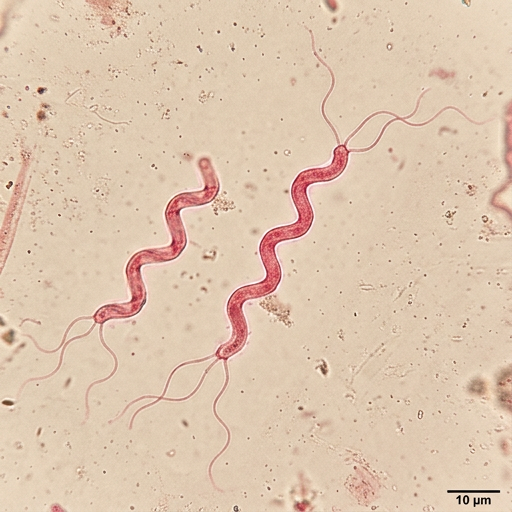
| Shape | Spirilla |
| Mobility | Yes |
| Flagellar presence | Yes |
| Number of membranes | Not Available |

Image source: Wikipedia/Wikimedia
| Ecology, Host, and Life Cycle | |
|---|---|
| Oxygen requirements | Anaerobic |
| Optimal temperature | Not Available |
| Temperature range | Not Available |
| Habitat | Multiple |
| Biotic relationship | Not Available |
| Host(s) | Homo sapiens |
| Cell arrangement | Filaments |
| Sporulation | Nonsporulating |
| Energy source | Chemoheterotroph |
| Pathogenicity | Not Available |
Genome Summary
MAG TPA_asm: Treponema sp. isolate UBA12037 contig_1652, whole
Gene Summary
Adenine Count
937238 bp
Thymine Count
935457 bp
Guanine Count
1494996 bp
Cytosine Count
1493830 bp
Genome Length
4863556 bp
Protein-coding Genes
4259 genes
Non-Coding Genes
48 genes
# of Chromosomes/Plasmids
2
Genes
| Name | Locus Tag | UniProt ID | Strand Orientation | Gene Start/End | Protein Molecular Weight |
|---|---|---|---|---|---|
| acetolactate synthase large subunit | DIC34_07810 | Not Available | Positive | 1701106 - 1701924 | 29220.8 |
| acetolactate synthase small subunit | DIC34_07815 | Not Available | Positive | 1701926 - 1702426 | 18568.6 |
| hypothetical protein | DIC34_07820 | Not Available | Negative | 1702436 - 1703446 | 37094.7 |
| sugar abc transporter permease | DIC34_07825 | Not Available | Positive | 1703635 - 1704528 | 33113.1 |
| sugar abc transporter permease | DIC34_07830 | Not Available | Positive | 1704538 - 1705443 | 33023.3 |
| sugar abc transporter substrate-binding protein | DIC34_07835 | Not Available | Positive | 1705521 - 1706846 | 47878.9 |
| diguanylate cyclase response regulator | DIC34_07845 | Not Available | Negative | 1707646 - 1708890 | 47307.2 |
| two-component system response regulator | DIC34_07850 | Not Available | Negative | 1708905 - 1709345 | 15638.2 |
| hypothetical protein | DIC34_07855 | Not Available | Positive | 1709517 - 1710743 | 44908.9 |
| hypothetical protein | DIC34_07860 | Not Available | Positive | 1710740 - 1711210 | 17052.5 |
Pathways
0 pathways
No pathways found
No metabolic pathways have been associated with this bacterium yet.
Health Effects
No health effects information available for this bacterium.