
Kingdom
Pseudomonadati
Phylum
Myxococcota
Class
Myxococcia
Order
Myxococcales
Family
Myxococcaceae
Genus
Myxococcus
Description
Taxonomy
| Kingdom | Pseudomonadati |
|---|---|
| Phylum | Myxococcota |
| Class | Myxococcia |
| Order | Myxococcales |
| Family | Myxococcaceae |
| Genus | Myxococcus |
| Species | Myxococcus fulvus |
| Strain | No strain |
Profile
| Physiology | |
|---|---|
| Gram staining properties | Negative |
| Shape | Cocci |
| Mobility | Not Available |
| Flagellar presence | Yes |
| Number of membranes | Not Available |
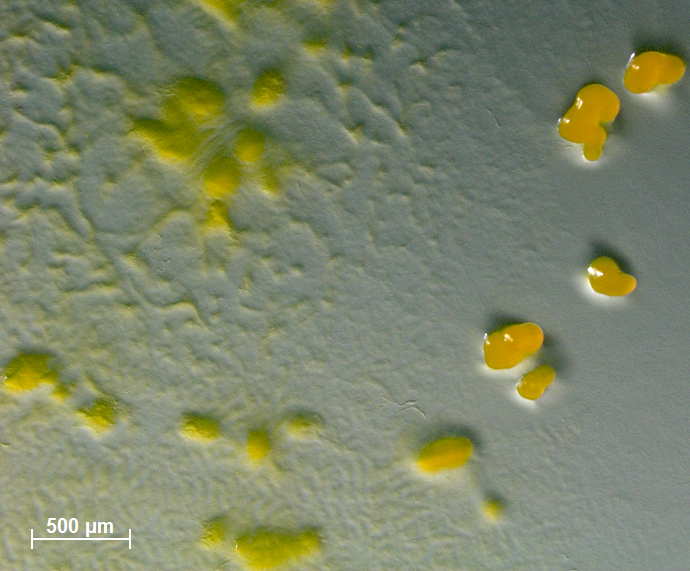
Image source: Wikipedia/Wikimedia
| Ecology, Host, and Life Cycle | |
|---|---|
| Oxygen requirements | Not Available |
| Optimal temperature | Not Available |
| Temperature range | Not Available |
| Habitat | compost |
| Biotic relationship | Not Available |
| Host(s) | Not Available |
| Cell arrangement | Not Available |
| Sporulation | Not Available |
| Energy source | Not Available |
| Pathogenicity | Not Available |
Gene Summary
Adenine Count
1615502 bp
Thymine Count
1631698 bp
Guanine Count
3810250 bp
Cytosine Count
3766219 bp
Genome Length
10824667 bp
Protein-coding Genes
8574 genes
Non-Coding Genes
79 genes
# of Chromosomes/Plasmids
1
Genes
| Name | Locus Tag | UniProt ID | Strand Orientation | Gene Start/End | Protein Molecular Weight |
|---|---|---|---|---|---|
| condensation domain-containing protein | SAMN05443572_1198 | Not Available | Positive | 10607716 - 10609185 | 54558.1 |
| uncharacterized conserved protein | SAMN05443572_1199 | Not Available | Negative | 10609164 - 10609529 | 13791.3 |
| acetyltransferase (isoleucine patch superfamily) | SAMN05443572_11910 | Not Available | Positive | 10609636 - 10610214 | 20857.4 |
| astacin (peptidase family m12a) | SAMN05443572_11911 | Not Available | Negative | 10610278 - 10611603 | 47379.6 |
| hypothetical protein | SAMN05443572_11912 | Not Available | Positive | 10611678 - 10612214 | 19466.1 |
| predicted oxidoreductase | SAMN05443572_11913 | Not Available | Negative | 10612254 - 10613120 | 30993.2 |
| transcriptional regulator, lysr family | SAMN05443572_11914 | Not Available | Positive | 10613226 - 10614125 | 33088.1 |
| regulatory protein, luxr family | SAMN05443572_11915 | Not Available | Negative | 10614018 - 10614896 | 32259.8 |
| dna-binding transcriptional regulator, marr family | SAMN05443572_11916 | Not Available | Positive | 10615113 - 10615652 | 19383.6 |
| h+/cl-antiporter clca | SAMN05443572_11917 | Not Available | Positive | 10615639 - 10617525 | 65270.1 |
Pathways
0 pathways
No pathways found
No metabolic pathways have been associated with this bacterium yet.
Health Effects
No health effects information available for this bacterium.
