
Kingdom
Pseudomonadati
Phylum
Myxococcota
Class
Myxococcia
Order
Myxococcales
Family
Myxococcaceae
Genus
Myxococcus
Description
Taxonomy
| Kingdom | Pseudomonadati |
|---|---|
| Phylum | Myxococcota |
| Class | Myxococcia |
| Order | Myxococcales |
| Family | Myxococcaceae |
| Genus | Myxococcus |
| Species | Myxococcus fulvus |
| Strain | No strain |
Profile
| Physiology | |
|---|---|
| Gram staining properties | Negative |
| Shape | Cocci |
| Mobility | Not Available |
| Flagellar presence | Yes |
| Number of membranes | Not Available |
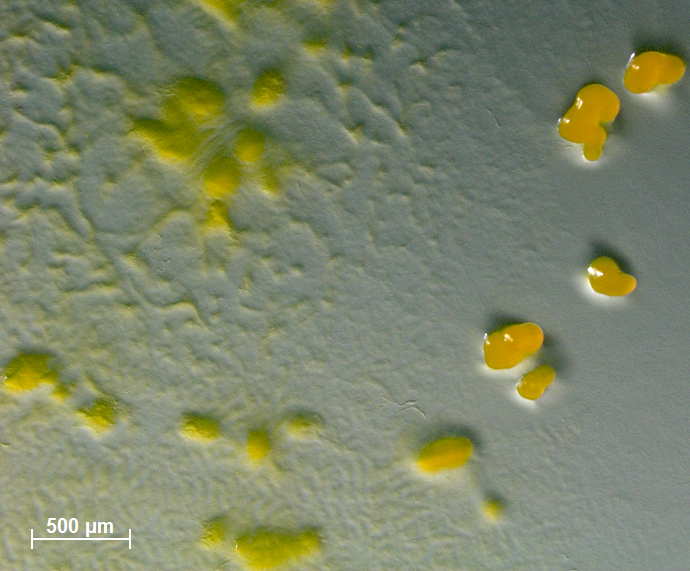
Image source: Wikipedia/Wikimedia
| Ecology, Host, and Life Cycle | |
|---|---|
| Oxygen requirements | Not Available |
| Optimal temperature | Not Available |
| Temperature range | Not Available |
| Habitat | compost |
| Biotic relationship | Not Available |
| Host(s) | Not Available |
| Cell arrangement | Not Available |
| Sporulation | Not Available |
| Energy source | Not Available |
| Pathogenicity | Not Available |
Gene Summary
Adenine Count
1615502 bp
Thymine Count
1631698 bp
Guanine Count
3810250 bp
Cytosine Count
3766219 bp
Genome Length
10824667 bp
Protein-coding Genes
8574 genes
Non-Coding Genes
79 genes
# of Chromosomes/Plasmids
1
Genes
| Name | Locus Tag | UniProt ID | Strand Orientation | Gene Start/End | Protein Molecular Weight |
|---|---|---|---|---|---|
| trna/rrna methyltransferase | SAMN05443572_10750 | Not Available | Positive | 6486768 - 6487517 | 27081.0 |
| hypothetical protein | SAMN05443572_10751 | Not Available | Positive | 6487637 - 6488674 | 37660.7 |
| 23s rrna pseudouridine1911/1915/1917 synthase | SAMN05443572_10752 | Not Available | Negative | 6488724 - 6489620 | 33018.4 |
| colicin import membrane protein | SAMN05443572_10753 | Not Available | Positive | 6489796 - 6490413 | 22145.9 |
| protein of avirulence locus involved in temperature-dependent protein secretion | SAMN05443572_10754 | Not Available | Positive | 6490486 - 6491382 | 32313.2 |
| beta/gamma crystallin | SAMN05443572_10755 | Not Available | Negative | 6491396 - 6494353 | 107218.0 |
| protein of unknown function | SAMN05443572_10756 | Not Available | Negative | 6494571 - 6496703 | 76873.9 |
| hypothetical protein | SAMN05443572_10757 | Not Available | Positive | 6496842 - 6497423 | 21114.2 |
| hypothetical protein | SAMN05443572_10758 | Not Available | Positive | 6497420 - 6498409 | 36669.1 |
| hypothetical protein | SAMN05443572_10759 | Not Available | Negative | 6498406 - 6498567 | 5840.45 |
Pathways
0 pathways
No pathways found
No metabolic pathways have been associated with this bacterium yet.
Health Effects
No health effects information available for this bacterium.
