
Kingdom
Pseudomonadati
Phylum
Myxococcota
Class
Myxococcia
Order
Myxococcales
Family
Myxococcaceae
Genus
Myxococcus
Description
Taxonomy
| Kingdom | Pseudomonadati |
|---|---|
| Phylum | Myxococcota |
| Class | Myxococcia |
| Order | Myxococcales |
| Family | Myxococcaceae |
| Genus | Myxococcus |
| Species | Myxococcus fulvus |
| Strain | No strain |
Profile
| Physiology | |
|---|---|
| Gram staining properties | Negative |
| Shape | Cocci |
| Mobility | Not Available |
| Flagellar presence | Yes |
| Number of membranes | Not Available |
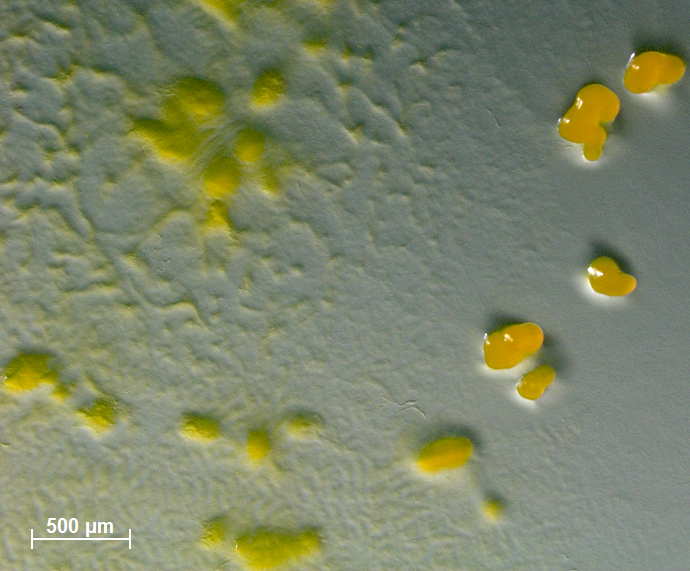
Image source: Wikipedia/Wikimedia
| Ecology, Host, and Life Cycle | |
|---|---|
| Oxygen requirements | Not Available |
| Optimal temperature | Not Available |
| Temperature range | Not Available |
| Habitat | compost |
| Biotic relationship | Not Available |
| Host(s) | Not Available |
| Cell arrangement | Not Available |
| Sporulation | Not Available |
| Energy source | Not Available |
| Pathogenicity | Not Available |
Gene Summary
Adenine Count
1615502 bp
Thymine Count
1631698 bp
Guanine Count
3810250 bp
Cytosine Count
3766219 bp
Genome Length
10824667 bp
Protein-coding Genes
8574 genes
Non-Coding Genes
79 genes
# of Chromosomes/Plasmids
1
Genes
| Name | Locus Tag | UniProt ID | Strand Orientation | Gene Start/End | Protein Molecular Weight |
|---|---|---|---|---|---|
| hypothetical protein | SAMN05443572_106373 | Not Available | Positive | 6130484 - 6131017 | 19573.5 |
| hypothetical protein | SAMN05443572_106374 | Not Available | Positive | 6131071 - 6131457 | 14560.4 |
| elwxxdgt repeat-containing protein | SAMN05443572_106375 | Not Available | Positive | 6131568 - 6132986 | 48832.7 |
| 40-residue yvtn family beta-propeller repeat-containing protein | SAMN05443572_106376 | Not Available | Negative | 6132990 - 6135734 | 96336.0 |
| sulfate permease, sulp family | SAMN05443572_106377 | Not Available | Negative | 6135900 - 6137642 | 59678.1 |
| two-component system, ntrc family, sensor histidine kinase glrk | SAMN05443572_106378 | Not Available | Positive | 6137915 - 6139384 | 51979.8 |
| two-component system, ntrc family, response regulator glrr | SAMN05443572_106379 | Not Available | Positive | 6139381 - 6140802 | 52651.3 |
| hypothetical protein | SAMN05443572_106380 | Not Available | Positive | 6140865 - 6141272 | 14445.3 |
| lsu ribosomal protein l33p | SAMN05443572_106381 | Not Available | Positive | 6141377 - 6141541 | 6333.81 |
| gtpase, g3e family | SAMN05443572_106382 | Not Available | Positive | 6141538 - 6142782 | 46280.8 |
Pathways
0 pathways
No pathways found
No metabolic pathways have been associated with this bacterium yet.
Health Effects
No health effects information available for this bacterium.
